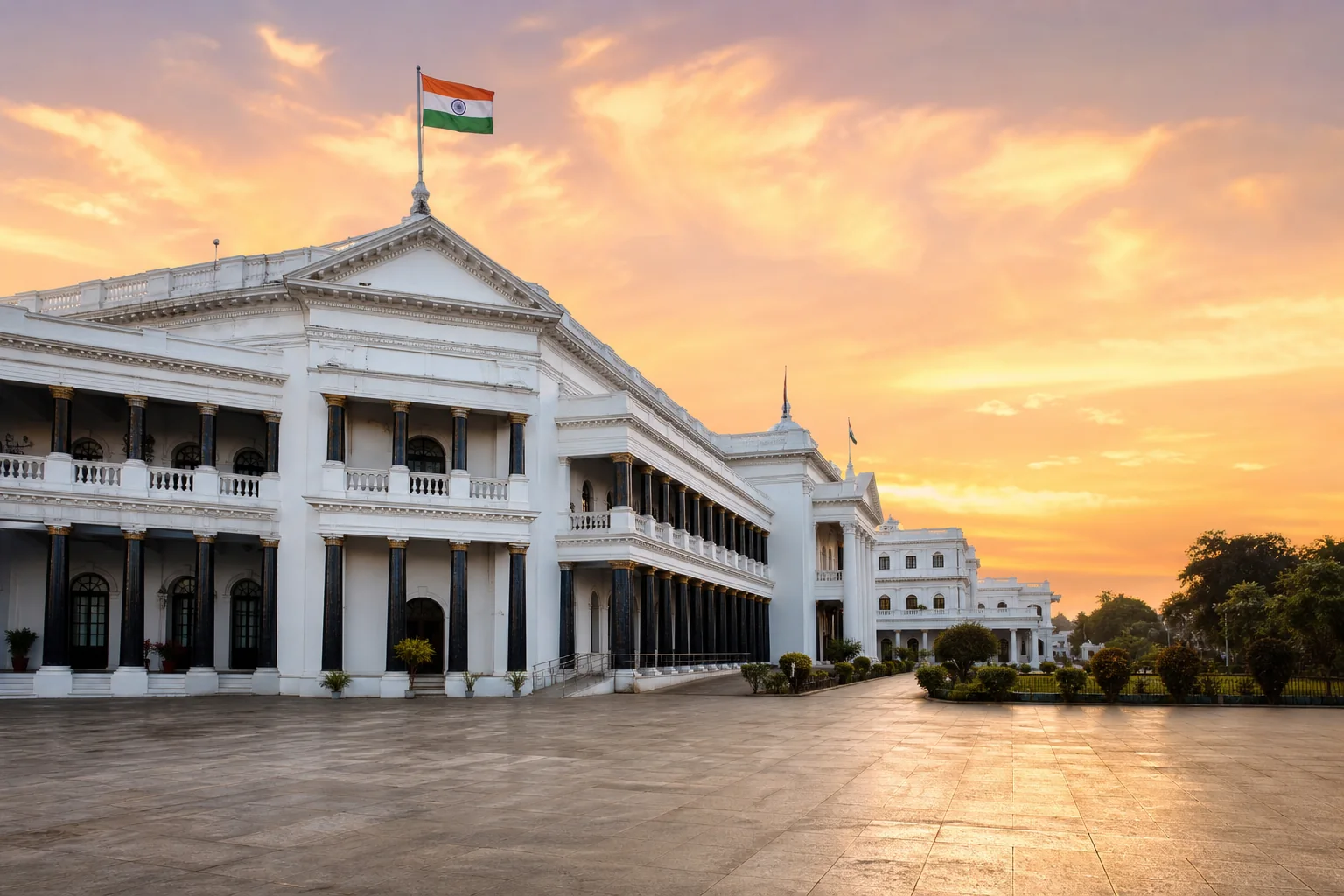
Fifty Years of DMK–AIADMK. Then One Election Broke the Habit
The DMK–AIADMK duopoly broke. A TVK-led coalition took Fort St. George. Here is the political shift — without the scheme laundry list.
For half a century, Tamil Nadu’s Assembly story was a two-party loop. One Dravidian party governed; the other waited. Allies orbited. New outfits rose and fell at the margins. 2026 broke that loop.
Tamilaga Vettri Kazhagam (TVK) formed a government under Chief Minister C. Joseph Vijay — not as a guest in someone else’s cabinet, but as the party holding the centre of a coalition. That is the change that still matters months later, even after the headlines move on to schemes and Budgets.
This piece is about power and structure. For school toilets, gold schemes, Metro corridors or monsoon pumps, use the linked explainers — those are separate stories on purpose.
The duopoly, 1967–2026: a habit voters finally interrupted
Since 1967, when the DMK first defeated Congress and captured Fort St. George, Tamil Nadu politics organised around Dravidian major parties. The AIADMK split from the DMK in 1972 and turned the state into a pendulum: one bloc wins; the other rebuilds. Congress, once the centre, became a junior partner or outsider. National parties nibbled at margins. Local outfits flared — PMK, DMDK, NTK — but the question on election eve was usually binary: DMK or AIADMK?
That habit shaped everything — cabinet composition, welfare branding, bureaucratic continuity. Schemes launched under Jayalalithaa often survived under Karunanidhi and Stalin. DMK laptop distributions continued under AIADMK interludes. Amma Unavagam, launched in 2013, kept running when the DMK returned in 2021. The Public Distribution System crossed every boundary because cutting grain is politically lethal. Welfare became a shared language with different accents.
The 2026 election did not erase that welfare architecture. It erased the two-party assumption about who gets to run it. TVK’s victory meant a debutant party — born from mass cinema fandom turned political organisation — would not merely support a Dravidian lead but hold the Chief Minister’s chair itself. That had not happened since the Dravidian model matured.
The duopoly ended — and something messier began
Until 2026, most voters could treat “who will form the government?” as a binary. The 2026 verdict forced a different sentence: who will sit with whom, and on what terms?
TVK’s numbers made it the natural lead. But the cabinet that followed was not a single-party fortress. Congress entered the state ministry for the first time since 1967. VCK and IUML took berths. Left parties backed from outside. Tamil Nadu’s first multi-party cabinet in nearly five decades is not a footnote — it changes how bills are negotiated, how dissent is managed, and how a Chief Minister spends political capital.
The arithmetic was proved early. On 13 May 2026, three days after Vijay’s swearing-in, the government carried a confidence motion with 144 votes — a majority that included a bloc of rebel AIADMK MLAs and detonated a parallel crisis inside AIADMK over disqualifications. TVK did not win a pure party landslide sufficient to ignore allies. It won enough to lead, then had to negotiate every week after.
The 2026 election did not only replace a Chief Minister. It replaced a fifty-year habit of one-party cabinets.
A coalition government has to keep allies visible without looking like it outsourced the mandate. Watch portfolio shares, Assembly floor management, and which party gets credit when a scheme launches. Those are the new politics — quieter than campaign rallies, more decisive than them.
Congress’s return to a state ministry after 59 years is the symbolic break. The party that ruled pre-1967 Tamil Nadu now holds Higher Education and other files under a non-Dravidian Chief Minister. VCK and IUML inside the cabinet represent social-justice and minority-politics constituencies that Dravidian majors often allied with but rarely shared power with so openly. Left support from outside adds another veto point on fiscal and labour questions.
Who holds the keys now
The Council of Ministers is the clearest map of intent.
C. Joseph Vijay kept Home, police, public and municipal administration with himself. That is a statement: law-and-order and city governance will not be delegated away from the CM’s desk in year one.
Around him, the mix is deliberate:
- A first-time educationist-MLA — N. Marie Wilson — on Finance
- A nine-term veteran — K.A. Sengottaiyan — on Revenue and Disaster Management
- A dedicated AI & IT ministry under R. Kumar (Tamil Nadu is only the second Indian state, after Kerala, to put AI at cabinet rank)
- School Education with A. Rajmohan; Higher Education with Congress’s P. Viswanathan
- HR&CE with S. Ramesh, whose early temple inspections set a public tone
New parties often centralise everything under the leader. TVK did centralise Home — and then spread specialist files to people with domain CVs. That hybrid is the institutional signature of 2026.
The roster also reveals what TVK chose not to centralise. Finance went to a first-term MLA with an education background, not to a film-industry insider. Revenue and disaster went to Sengottaiyan’s experience across nine terms. AI went to a Velachery MLA tasked with building state capacity in a field most cabinets treat as a press release. Prohibition and Excise went to K. Vignesh — early liquor-shop orders near schools and temples signalled that campaign morality politics would convert to G.O.s quickly. (Dated scorecard.)
Style of power: visible files, inherited welfare
The first months showed a priority order, not a full term: liquor near schools, canteen repair without renaming, DVAC and temple inspections, Metro continuity with contested greenfield pauses, monsoon reviews before the Northeast season. The style is visible action on files voters can see or fear — under a debutant treasury that Finance later said needed years to heal.
Those beats are told properly elsewhere: first 100 days for the chronology, Amma Unavagam for the plate test, infrastructure for Parandur versus Metro, Budget for money and manifesto gaps.
Tamil Nadu’s welfare state is sticky by design. The new administration’s early message was not “delete the past.” It was inspect, repair, rename where useful, fund what matches the campaign. Opposition leaders call many announcements “stickers on old schemes.” Supporters call them delivery. Both can be partly true. The structural change is simpler: a party that never governed before now owns the file that keeps those schemes alive — including awkward rival-era brands.
Scheme lineage — Jayalalithaa’s marriage-gold names versus TVK’s Annan Seer, DMK laptops versus Vetri Laptop — is branding politics on a persistent welfare instinct. The citizen’s schemes guide maps old versus new without pretending the underlying state vanished.
What voters should not confuse with “change”
Three traps show up in every post-election year:
- Announcements ≠ outcomes. A Budget line is a permission slip, not a finished school toilet.
- Campaign ≠ cabinet. Several high-visibility manifesto items did not appear in the first revised Budget — absence is information. (What was funded vs deferred.)
- Charisma ≠ capacity. Vijay’s personal popularity won the election; district collectors, engineers and teachers will decide whether the term feels different in Coimbatore or Cuddalore.
A fourth trap is particular to 2026: coalition harmony ≠ policy silence. Allies who share ministries also compete for credit in their constituencies. Congress Higher Education and TVK School Education must coordinate; VCK social-justice expectations must align with Finance’s fiscal caution; IUML minority-welfare priorities must fit a common floor strategy. Disagreements that once stayed inside DMK or AIADMK rooms now cross party lines in public.
Vijay’s popularity opened Fort St. George. Collectors, teachers and municipal engineers will decide whether anything feels different at the ground level.
Opposition geography after the duopoly
DMK and AIADMK still command significant vote shares and organisational depth. Leader of Opposition Udhayanidhi Stalin and AIADMK’s Edappadi Palaniswami attacked the first Budget as rebrand theatre. Their cooperation is tactical, not merged — each party wants to be the primary alternative if TVK stumbles.
Smaller forces recalibrated too. NTK remains an ideological critic outside power. PMK and BJP adjust alliance math for future bypolls. The 2026 change is not the disappearance of old parties; it is the centre of gravity moving to a third pole that does not need either Dravidian major to form a government.
For how Vijay built that pole, read the rise of Joseph Vijay. For how Stalin’s DMK lost the loop, see the long defeat.
Institutional firsts that will outlast the honeymoon
Three cabinet choices matter for governance design more than for day-one headlines:
AI at cabinet rank. Kerala preceded Tamil Nadu, but R. Kumar’s ministry still signals that data and automation policy will be coordinated at secretary level rather than scattered across IT and Industries.
Finance in fresh hands. N. Marie Wilson is a first-time MLA holding the exchequer during a turnaround narrative — welfare optimism paired with public caution about inherited stress.
HR&CE under activist management. S. Ramesh’s early temple inspections telegraphed that religious administration would be treated as a corruption file, not only a ceremonial one.
How to read the rest of the term
If 2026 changed the who, the remaining years will be judged on the how:
- Can a coalition stay coherent through bypolls and ally pressure?
- Can a debutant Finance Minister sell fiscal repair without starving welfare?
- Can specialist ministers — AI, education, disaster — outlast the launch photos?
- Will contested projects be decided by manifesto memory or by fresh studies?
Delivery scorecards live in the sibling pieces — schools, stipends, wedding gold, metros, monsoon pumps. The structural question — can a third force govern without reverting to duopoly habit — unfolds slower, in bypolls, ally defections, and whether TVK builds a bench beyond its star leader.
The sentence that replaces the old loop
Before 2026, the post-election sentence was predictable: the Dravidian winner takes Fort St. George, keeps most welfare files alive, rebrands a tranche, and the loser prepares for the next swing. After 2026, the sentence is conditional: TVK leads a coalition, inherits rival schemes, chooses repair and rename selectively, and faces a two-headed opposition while allies demand share.
The election changed the authors of Tamil Nadu’s Government Orders. For fifty years, voters knew who would write the next chapter. Now they watch whether a new author can keep the plot coherent.