Why Metro Got the Money and Parandur Didn't: Tamil Nadu's Real Build List for 2026
Metro Phase II, a ₹2,117-crore urban mission and AI planning tools are moving — while Parandur airport and several marquee city brands stayed out of the first Budget.
Infrastructure debates in Tamil Nadu usually sound louder than the Budget lines that fund them. The TVK government’s first months — capped by the 2026–27 revised Budget — drew a sharper line than most campaigns do: continue working corridors, fund urban basics, study the moonshots, and pause projects the party fought in opposition.
This guide separates what is moving from what is waiting, with a focus on Chennai and statewide capital works citizens actually feel.
Why infrastructure politics in Tamil Nadu is never just engineering
Every Tamil Nadu government inherits a portfolio of half-built dreams. Elevated corridors promised in one term stall in the next. A greenfield airport site clears land, then faces a new Chief Minister who campaigned against it. Metro tunnels advance while stormwater drains lag two streets away. The TVK administration’s first Budget did not try to fund everything; it tried to sequence — a word bureaucrats use and voters feel when the bus arrives before the airport.
Chennai is the gravitational centre — home to roughly a tenth of the state’s population, the bulk of IT and automotive investment, and the most photographed flood zones — but the 2026 capital story extends to SIPCOT estates in backward districts, a space investment zone framing in the south, and a feasibility study for Arivagam, an AI city brand that exists more in PowerPoint than on ground today. Understanding what moved requires reading both rupee lines and political memory.
Mobility first where diggers already are — Metro Phase II and e-buses beat brochure cities.
Chennai Metro: from Phase I scepticism to Phase II momentum
A brief history citizens still reference
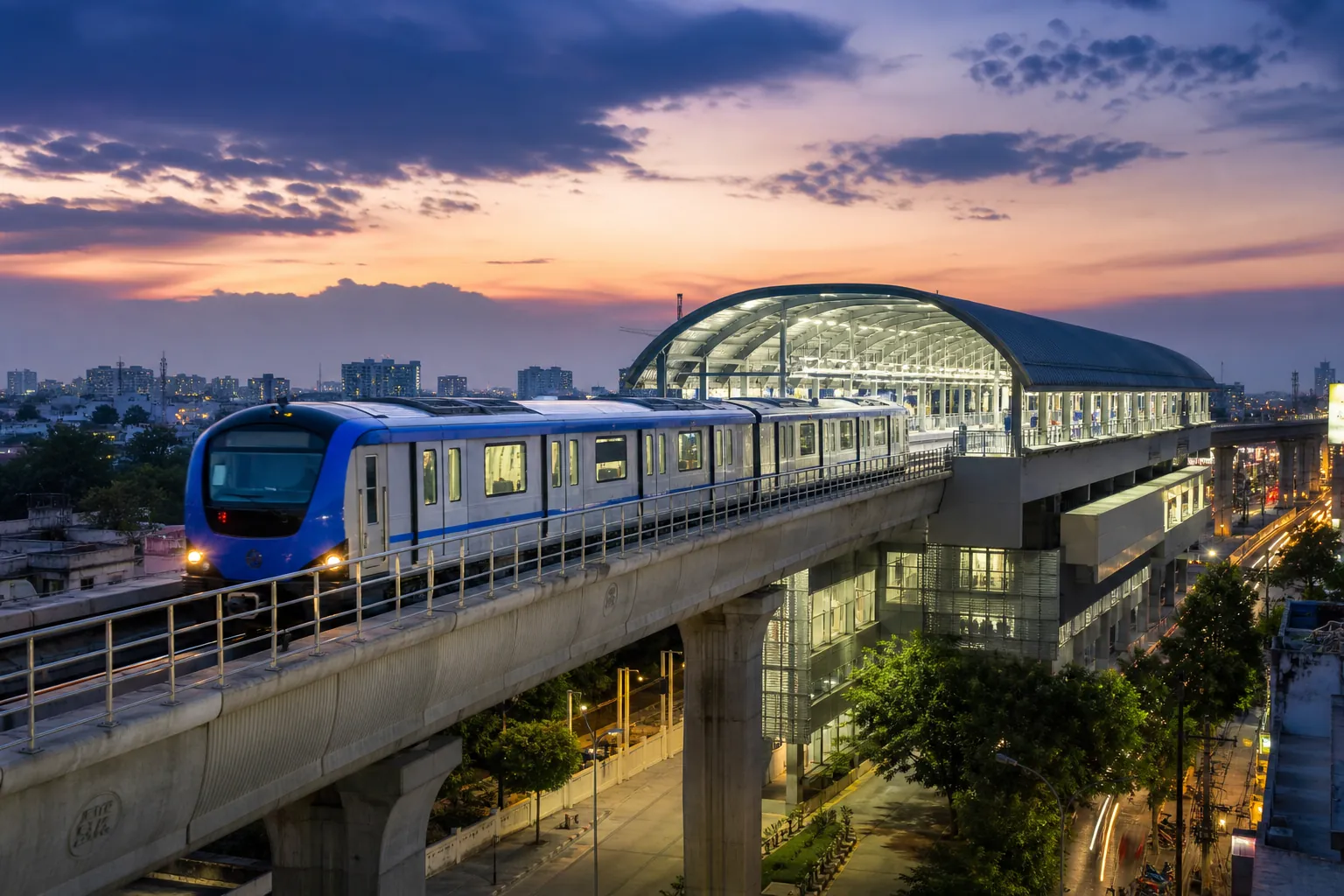
Chennai Metro did not arrive without controversy. Phase I — the Blue Line from Washermanpet to Chennai Airport and the Green Line from Central to St. Thomas Mount — opened in stages between 2015 and 2019, years after Delhi and Bengaluru had already normalised urban rail. Early ridership fell below projections; critics called it an expensive vanity project; supporters argued Chennai’s dispersed sprawl needed time to grow into the network.
By the mid-2020s, the argument had shifted. Phase I corridors began carrying meaningful daily loads; property markets along stations repriced; and Phase II — a multi-corridor expansion approved before the 2026 election — was already under construction when TVK took office. That distinction matters: inherited diggers face a lower political bar than fresh land acquisition.
Phase II adds roughly 118 km across three corridors, extending the network toward Poonamallee, Light House, Madhavaram and beyond. The CMRL (Chennai Metro Rail Limited) model — joint venture between the Government of India and the Government of Tamil Nadu — means Union approvals and cost-sharing debates continue alongside state Budget allocations.
What is clearly moving now
The first 14.64 km stretch with 11 stations from Poonamallee Bypass is on a near-term commissioning track. The state continues to seek Union approvals for extra corridors — including links toward Kilambakkam, Avadi/Pattabiram and Sriperumbudur — and keeps advocating a Hosur–Bommasandra metro tie-in with Bengaluru’s network. Metro is the rare big project that is both politically safer and already under construction.
For daily commuters, the Poonamallee stretch matters because western Chennai — Porur, Poonamallee, Iyyappanthangal — has grown faster than road capacity. Kilambakkam integration connects the metro story to the Moffusil Bus Terminus; Avadi and Sriperumbudur links speak to the industrial workforce in the Oragadam–Sriperumbudur belt.
What is clearly moving
Chief Minister’s Integrated Urban Development Mission
A single urban envelope — water supply, sewerage, transport, public health, solid waste, green spaces and AI-enabled city management — with about ₹2,117 crore for the year. Think of it as the “keep cities functioning” budget, not a skyline brochure.
The mission’s structure reflects a lesson Chennai learned painfully in 2015 and again during Cyclone Michaung: cities fail on operations and maintenance before they fail on lack of marquee towers. Water supply rehabilitation, sewerage network patching, solid-waste transfer stations, and public-health infrastructure in dense wards are unglamorous line items that determine whether urban life continues during a crisis. The “AI-enabled city management” clause connects to Minister R. Kumar’s portfolio and the SPEED approvals platform — governance software as infrastructure.
Electric buses for Chennai
Procurement of 1,000 air-conditioned electric buses, with about ₹500 crore flagged for depot infrastructure. This is how most Chennai commuters will meet “green mobility” long before any AI city gate opens.
Expanded CMA master plan
₹25 crore to CMDA for a comprehensive master plan covering the expanded Chennai Metropolitan Area (5,904 sq km). The map of Chennai’s growth is being redrawn; the plan is the rulebook for that map.
The 5,904 sq km figure — expanded from an earlier 1,189 sq km core — brings satellite towns, industrial corridors and peri-urban panchayats under one planning lens. That includes growth pressure along GST Road, OMR, and the Ennore–Manali industrial belt where port-linked logistics and thermal infrastructure meet residential spillover. A master plan does not build roads; it decides where roads may be built — the document that prevents ad hoc layout approvals from eating flood plains and agricultural fringes.
Housing continuum
Housing and Urban Development allocation raised to about ₹8,852 crore. Multi-storeyed tenements already in progress (tens of thousands of units) are to be completed or started through the year, alongside beneficiary-led housing and a longer MY-HOME-style rental push aiming toward one lakh units in Chennai over about seven years (PPP).
SPEED planning approvals
₹40 crore for SPEED (Single Platform for Efficient Expedited Development) — an AI-enabled online system integrating CMDA, DTCP and local bodies so building and layout permissions stop bouncing between counters. Digital services explainer.
Ennore, Manali and the northern industrial belt
North Chennai’s Ennore–Manali corridor is Tamil Nadu’s heavy-industry face: port facilities, thermal power stations, refineries and logistics yards along the Kosasthalaiyar basin. It is also a flood-vulnerable landscape where industrial encroachment on wetlands has been litigated for decades. Infrastructure planning here is not only about moving goods — it is about coastal ecology, resettlement and multi-modal connectivity between port, rail and road.
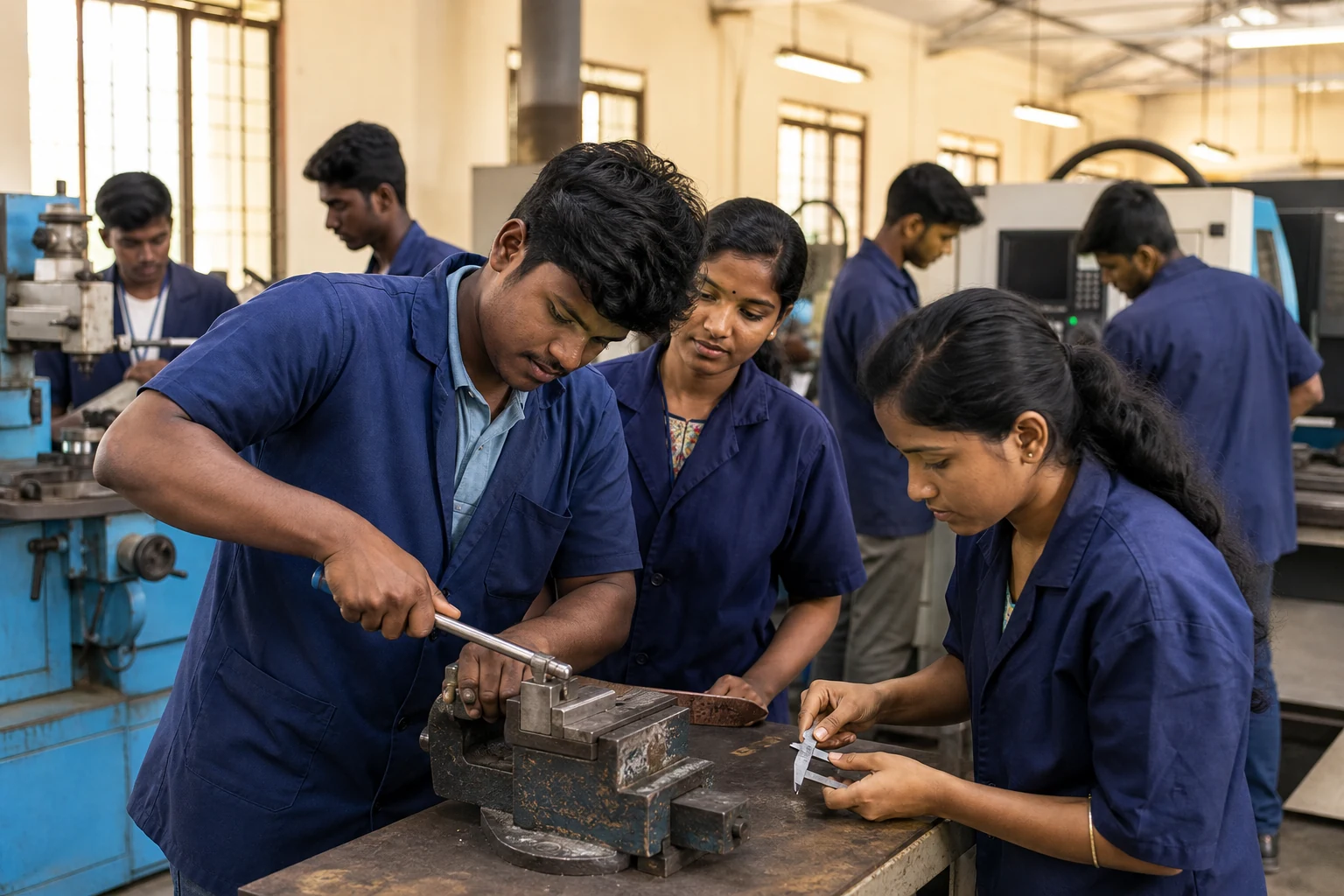
SIPCOT estates in less congested districts — funded at about ₹3,200 crore over five years — partly reflect a policy preference to spread new factory floors rather than concentrate all growth in Ennore’s shadow.
Statewide bets beyond the city
- Arivagam — pitched as India’s first dedicated AI and innovation city (AI university, skill centre, semiconductor test lab, incubators). Budget reality check: ₹5 crore for a feasibility study, not a full build-out yet.
- SIPCOT — new industrial parks in industrially backward districts, about ₹3,200 crore over five years.
- Space industrial framing — Thoothukudi–Tirunelveli as a space investment zone linked to Kulasekarapattinam, with an IN-SPACe-linked common technical facility proposed.
- Logistics and ports — more multi-modal logistics parks, coastal economic push, and exploration of new port capacity (announcement-stage).
- New Industrial Policy — promised refresh focused on tech-led and export-oriented growth.
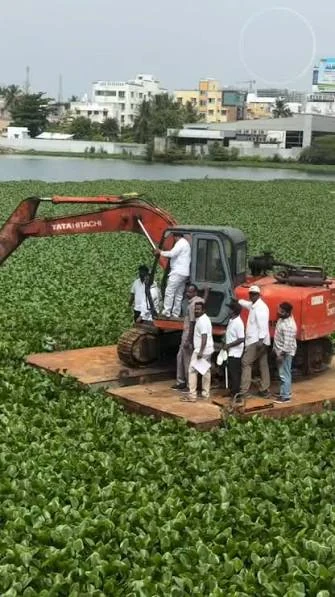
- Flood and water works — Chennai short-term mitigation and Cauvery-basin pre-monsoon clearance (see monsoon preparedness).
Arivagam deserves a sober read: ₹5 crore for feasibility is orders of magnitude below what a dedicated AI city requires. Treat it in 2026 as a planning exercise, not a construction site.
What the first Budget sidelined
Coverage of the maiden Budget repeatedly noted missing high-profile names:
- Parandur greenfield airport
- Hosur airport / Rameswaram airport proposals
- Hosur TIDEL Park, Chennai Global City, Chennai Tech City
- Hosur Knowledge Corridor, Chennai Sports City
- A dramatic FSI hike narrative as a Budget centrepiece
Absence is not always cancellation — but it is a sequencing choice. Welfare, schools, skills and urban O&M took the microphone; several capital marquee projects did not get fresh timelines or allocations.
The missing names share a pattern: large land footprints, long gestation and opposition-era controversy. TVK campaigned as a party willing to block projects it considered environmentally or socially harmful. Governing requires converting that posture into policy — continue inherited metros, pause inherited airports, fund feasibility for new-economy branding.
Parandur: the political infrastructure story
Parandur is the clearest example. Announced under the previous government, it already had site clearances and substantial land processes under way. As TVK president, Vijay had joined villagers opposing destruction of waterbodies and farmland. In office, Energy & Law Minister R. Nirmalkumar said the party remains firm against the Parandur site, is not against an airport, and will explore an alternative location.
That stance has trade-offs industry groups are quick to list: new site selection, AAI studies and clearances can add years. For citizens, the honest summary is: second airport capacity is still a state goal; this specific site is not the government’s preferred path.
Why Parandur became a symbol
Parandur sits in Kancheepuram district, northeast of Chennai, on agricultural land interlaced with waterbodies and irrigation channels. The previous administration’s greenfield airport proposal promised to relieve pressure on Chennai International Airport at Meenambakkam — which is operating near capacity and surrounded by urban density that makes runway expansion nearly impossible.
Villagers and environmental groups argued the site would destroy wetlands, displace farming communities and threaten groundwater recharge zones. Vijay’s visible alignment with protests during the campaign season made Parandur a litmus test for whether TVK would govern as it campaigned. Minister Nirmalkumar’s post-election statements — opposing the site, not the concept — attempt to preserve investor confidence while honouring that pledge.
Alternative sites and fresh AAI studies can add five to seven years even when politics cooperates. The TVK sequencing choice — urban basics and Metro first, airport site reset later — bets that commuters and flood-prone wards matter more in year-one credibility than a sod-turning ceremony at Parandur.
How to read Chennai’s next decade from these choices
- Mobility first where diggers already are — Metro Phase II and e-buses beat brochure cities.
- Governance plumbing — SPEED, master plan, urban mission.
- Moonshots on study mode — Arivagam and space-zone branding need land, funds and tenants after feasibility.
- Opposition memory matters — projects TVK campaigned against face a higher bar than inherited metros.
- Fiscal brake — mega greenfield bets compete with school and welfare spends under Finance’s two-year repair ask (Budget; Wilson profile). Infrastructure sequencing is fiscal policy dressed as engineering.
Citizen checklist
| Project | Status signal |
|---|---|
| Metro Phase II (Poonamallee stretch) | Near-term commissioning path |
| 1,000 e-buses + depots | Funded direction |
| Urban Development Mission | ₹2,117 crore this year |
| CMA 5,904 sq km master plan | ₹25 crore planning grant |
| SPEED approvals | ₹40 crore build |
| Arivagam | Feasibility (₹5 crore) |
| Parandur airport | Site opposed; alternative to be explored |
| Global/Sports/Tech City brands | Not in first Budget |
For the political arc behind these choices, see 100 days of decisions and what has changed since the election.
The honest citizen takeaway: 2026 is a maintenance-and-expansion year, not a greenfield carnival. Dig where shovels are already in the ground; study where land is still contested; pause where the party promised pause. Chennai’s next decade will be shaped as much by what TVK chooses not to build as by what it funds.