Tamil Nadu Promised a Super App. Here's What You Can Actually Do on Your Phone Today
From e-Sevai and SPEED building approvals to a promised Super App for hundreds of services — how Tamil Nadu is wiring daily government work after 2026.
Tamil Nadu’s digital story did not begin in 2026 — e-Sevai centres, online certificates and department portals already exist. What changed after the election is ambition and ownership: a cabinet AI & IT ministry, Budget money for an AI planning platform, and a vision document that talks about a Super App, time-bound services and even “no-application” welfare.
This guide is for citizens who want a practical split: what you can do today, what is being built, and what is still a vision slide.
Before the Super App: how Tamil Nadu got here
e-Sevai since 2011 — the assisted-digital backbone
Tamil Nadu rolled out e-Sevai centres in the early 2010s as part of a wider push to put certificate and tax services online while acknowledging a hard fact: millions of citizens would still need a human across the counter. The model — franchised or government-run centres with operators trained on departmental portals — became the state's compromise between "digital India" rhetoric and village bus-timetable reality.
By the mid-2010s, a resident in Thanjavur or Tenkasi could often apply for income or community certificates online, pay certain fees digitally, and collect printouts at a centre without bribing a middleman — not always, not everywhere, but often enough that e-Sevai became a verb in Tamil households. The centres also absorbed shock during COVID when departments wanted forms without crowds.
The limitation is structural: e-Sevai is a front window onto dozens of backend silos. Each department upgraded at its own pace. That is why a citizen might get a slick online experience for one service and a paper register still lurking behind another.
TNeGA and the governance reform layer
The Tamil Nadu e-Governance Agency (TNeGA) — rooted in the state's earlier e-governance missions — sits behind many portal integrations, data centre choices and standardisation efforts. TNeGA is not a household name like e-Sevai, but developers and district collectors know it as the agency that translates "Chief Minister wants one dashboard" into API arguments between departments.
Historically, TNeGA-era projects wrestled with the same enemy the 2026 government names openly: leakage. When databases do not talk, ghost beneficiaries survive. When they do talk — as Finance Minister N. Marie Wilson claimed with ₹15,000 crore mobilised through plugging gaps — digital reform becomes fiscal policy, not IT trivia.
Every party promises one app. Tamil Nadu already has hundreds of counters called e-Sevai. The Super App must beat that network, not merely photograph it.
What you can already do online (or at e-Sevai)
Across districts, residents routinely use digital or assisted-digital channels for:
- Birth, death and community / income / nativity certificate applications
- Property tax and certain municipal payments
- Ration-card related services and civil supplies queries
- Landing slots and status checks for registration offices
- Student and scholarship workflows through education portals
- Grievances via district and departmental helplines / apps
Exact menus differ by department version and local body. When in doubt, the nearest e-Sevai centre remains the equaliser for people without smartphones or stable data.
District reality: who still needs the counter
In Chennai Corporation wards, property tax and water charge payments online are routine for middle-class apartment associations. In Kanyakumari fishing hamlets, stable 4G is not; the e-Sevai operator is the entire UX team. In Coimbatore municipal pockets, building plan queries may still straddle DTCP portals and paper files depending on plot classification.
Citizens should assume version drift: the portal your neighbour used last year may have moved menus. Saving PDF receipts matters more than remembering a tutorial video.
What’s being built now
Vetri Tamil Nadu Super App
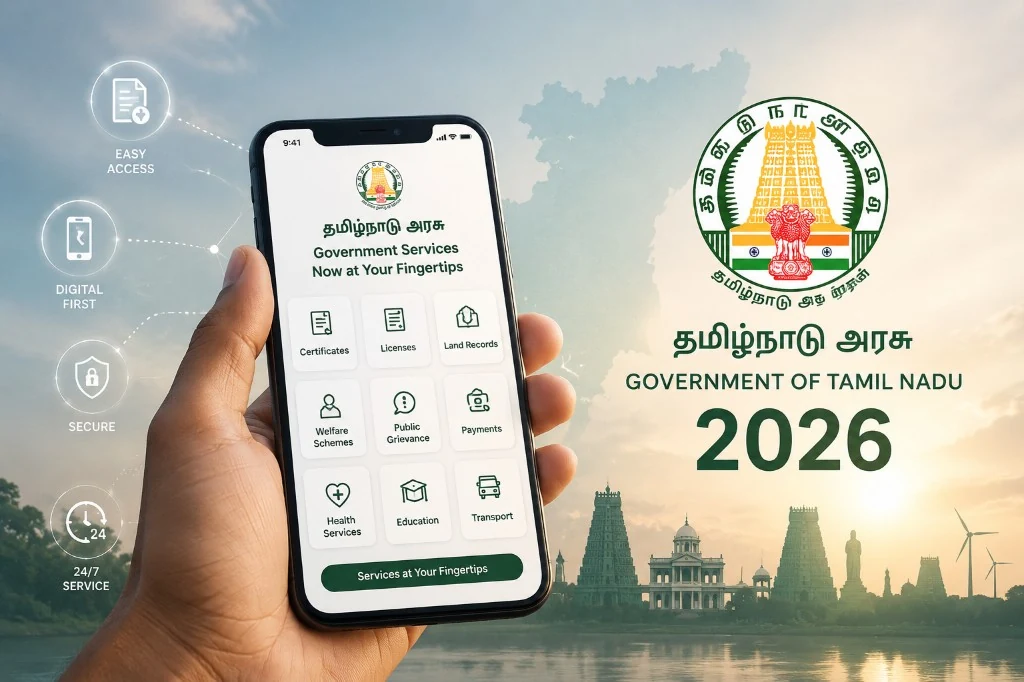
Ministers have described a Super App meant to put about 500 government services on a phone — examples cited in briefings include birth certificates, ration-card services and driving-licence renewals. Officials have said implementation is in process. Until the store listing and service catalogue are public, treat it as coming, not as a replacement for e-Sevai today.
The political branding — Vetri — ties digital identity to the wider 2026 vocabulary (Vetri Skill, Vetri Thamizhagam). That helps marketing. It also raises the stakes: if the app ships thin, the brand damage spreads across portfolios.
Super App vs e-Sevai: what citizens should expect
| Dimension | e-Sevai (existing) | Vetri Tamil Nadu Super App (promised) |
|---|---|---|
| Access model | Assisted + self-service portals | Mobile-first unified shell |
| Coverage | Broad, but department-by-department | ~500 services marketed as one catalogue |
| Rural bridge | Human operator compensates for digital literacy | Depends on UI simplicity and offline fallbacks |
| Payments | Mix of portal gateways | Intended in-app, TBD integration depth |
| Accountability | Centre operator + paper receipt | App timestamp + push notifications (if built) |
| Risk | Siloed backends persist | Single point of failure if backends not integrated |
Neither column wins automatically. e-Sevai works because a person can type for you. Super Apps win only when integration is real — not when they are browsers wrapping old URLs.
SPEED — AI-enabled planning approvals
The Budget allocates ₹40 crore for SPEED (Single Platform for Efficient Expedited Development). It is designed to integrate:
- Chennai Metropolitan Development Authority (CMDA)
- Directorate of Town and Country Planning (DTCP)
- Rural and urban local bodies
Goal: faster, more transparent building and layout permissions without file tourism. If SPEED works, architects, homebuilders and small developers feel it first — then housing supply and compliance improve for everyone else.
Tamil Nadu's construction frustration is not abstract. Files move between CMDA and local bodies; NOCs expire; digitisation without decision rules changes nothing. SPEED's AI label matters only if it encodes clearances, flags incomplete submissions and publishes status — not if it auto-generates polite rejection letters.
AI in routine administration
Beyond SPEED, the government has flagged AI-assisted workflows for clearances and, in vision papers, automated eligibility checks for welfare. The AI ministry exists to keep these from living only in manifesto PDFs.
Expanded CMA digital planning base
₹25 crore for a comprehensive master plan for the 5,904 sq km Chennai Metropolitan Area creates the data layer future online approvals will need. Bad maps make “smart” portals dumb. Planners have watched projects stall because cadastral overlays disagreed between departments. Wilson's capital allocations only work if this layer is authoritative — not decorative GIS.
Kerala vs Tamil Nadu: two southern AI ministry experiments
When Tamil Nadu created a cabinet-level AI & IT portfolio in 2026, comparisons with Kerala were instant. Kerala had already marketed itself as an AI-forward state — seminars, startup policies, skilling rhetoric — often without a standalone ministry with the same visibility.
| Topic | Kerala (pre-2026 track) | Tamil Nadu (2026 TVK) |
|---|---|---|
| Institutional form | AI spread across IT and planning bodies | Dedicated cabinet AI & IT ministry |
| Political story | Left-led digital welfare + startup pitch | Anti-leakage + Super App + SPEED |
| Scale anchor | Smaller state, dense fibre in pockets | Chennai corridor + statewide e-Sevai mesh |
| Risk | Pilot fatigue — many demos, uneven scale | Integration debt — huge state, siloed depts |
The comparison is not a scorecard. Kerala's population and urban form differ. But citizens should watch delivery cadence: Kerala's strength has been nimble pilots; Tamil Nadu's traditional strength has been scaling boring infrastructure — roads, buses, industrial parks — when politics allows. The AI ministry bet is that Tamil Nadu can combine scale with speed. The e-Sevai network is the hidden asset; the siloed databases are the hidden tax.
What’s still vision (watch, don’t wait)
From the Vetri Thamizhagam vision discussion reported ahead of the Budget:
- No-application welfare — benefits pushed to eligible citizens without a fresh form (ambitious; legally and data-wise hard)
- Right to Service Act style time guarantees for government services
- Arivagam AI city (currently a ₹5 crore feasibility line, not a login screen)
- Large state investment authority ideas for deep-tech sectors
Vision documents are useful for direction. They are not URLs.
Why "no-application welfare" is harder than it sounds
Automatic eligibility requires clean cross-matches: income tax traces, land records, ration databases, caste certificates, bank accounts. Tamil Nadu has pieces of each; integrating them triggers both technical bugs and political resistance from intermediaries who live on application friction. Finance Minister Wilson's leakage savings imply the state is willing to fight those intermediaries. Citizens should demand pilot districts with published error rates — wrongly excluded families matter as much as ghosts removed.
Right to Service and the clock citizens deserve
A Right to Service Act clone would finally give citizens a countdown — birth certificate in X days, pension correction in Y days. Without penalties for departmental delay, clocks are wallpaper. Watch whether the 2026 government attaches measurable penalties or only aspirational timelines.
Why digital governance is a political story
Every party promises “one app.” Delivery fails for boring reasons: departments refuse to share databases, last-mile offices keep parallel registers, and rural connectivity drops the session before payment. The TVK pitch ties digital reform to anti-leakage politics — the same Budget that claimed about ₹15,000 crore mobilised by plugging gaps also needs cleaner databases to make “no middleman” real.
For citizens, the test is simpler than any slogan:
- Can I finish the service without a broker?
- Do I get a timestamped acknowledgement?
- Is there a public SLA when the portal fails?
- Does the Super App reduce trips — or add a third password?
The Chennai IT corridor irony
Tidel Park and the OMR belt export software for the world while taluk offices sometimes still run on parallel registers. Digital Tamil Nadu is as much a story about inland offices catching up with coastal engineers as it is about AI ministers. The jobs plan needs digital rails too — stipends, scholarships and skill portals fail if Aadhaar-linked mobiles are wrong.
Practical tips until the Super App ships
- Prefer official.gov.in / tn.gov.in domains and the real e-Sevai network over lookalike apps.
- Save PDF acknowledgements and reference numbers.
- For building plans, ask your architect whether filings will move to SPEED in your local body and when training starts.
- Students: laptop and scholarship workflows will increasingly assume digital IDs — keep Aadhaar-linked mobile numbers updated.
- Seniors: e-Sevai assisted mode is still a right, not a failure.
Red flags that have not changed since 2011
- Unofficial "agents" outside e-Sevai centres promising faster certificates.
- Portals without HTTPS or with misspelled department names.
- Payment links that are personal UPI IDs.
- Any app asking for OTP twice without a logged-in service context.
Departmental scorecard: what to watch quarterly
Citizens do not need to read tender documents to audit progress. Ask for four public indicators each quarter:
- Super App — count of live services with end-to-end digital completion, not beta tiles.
- SPEED — median approval days for a standard residential plan in one CMDA zone and one rural body.
- e-Sevai — average turnaround for community certificate in three districts (one coastal, one western, one southern).
- Grievance closure — percentage closed within stated SLA on CM cell / district portals.
If numbers are not published, assume integration is still stuck in meeting rooms.
How this links to the rest of 2026 policy
Digital rails support the jobs and education stack and the infrastructure stack (approvals, metro-adjacent development). Create the AI ministry early, fund SPEED, promise the Super App — then spend the hard year wiring departments. Citizens need that wiring because every hour chasing paper is an hour not earned.
Bookmark this page and update your expectations when the Super App’s live service list is published — that catalogue, not the launch event, is the real product. Until then, e-Sevai remains Tamil Nadu's most honest digital interface: imperfect, staffed by humans, and still the place where the state meets people who will never read a vision document.