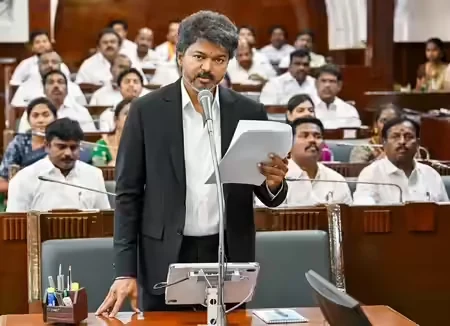
Can a Government School Still Feel Like a Choice? Tamil Nadu's 2026 Education Bet
Clean toilets, safer campuses, residential seats for talent without money, AI electives and anti-drug clubs — the 2026 education push as students and parents will meet it.
Most education Budget stories read like a shopping list. This one starts at the school gate — the place a Class VIII girl decides whether the toilet is usable, a Class XI boy wonders if the bicycle will actually arrive, and a parent asks whether "AI lab" means a locked cupboard or a weekly period.
School Education sits with Minister A. Rajmohan; Higher Education with Congress's P. Viswanathan. The money envelope is large — School Education alone carries ₹44,527 crore in the revised 2026–27 Budget — but money only becomes reform when a headmaster can point to a finished work order. (Fiscal context.)
Tamil Nadu did not arrive at this moment from nowhere. The state's public-school story is one of the longest welfare bets in India — and one of the most uneven in delivery.
Why Tamil Nadu still bets on the government school
In 1956, Chief Minister K. Kamarajar introduced the mid-day meal scheme in Madurai — a plate of rice that pulled children into classrooms and, over decades, became a national template. C. N. Annadurai's government pushed mass literacy; later DMK and AIADMK administrations competed on textbooks, uniforms, laptops, bicycles and canteens. The Dravidian welfare model treats the classroom as a dignity contract: if the state feeds you, clothes you and buses you, it earns the right to ask you to stay until Class XII.
That legacy is why a 2026 education Budget can sound ambitious without sounding exotic. Parents in Tirunelveli and Tiruppur still remember when a government school meant a leaking roof and a single working fan. They also remember when a colour television arrived in every classroom — a Jayalalithaa-era headline — or when the DMK's 2022–23 breakfast scheme became the first state-wide morning meal for primary children, later extended upward.
Tamil Nadu's education politics is not about whether the state should run schools. It is about whether the state can still make a government-school seat feel like a choice, not a consolation.
The TVK coalition inherits that history and adds a new layer: AI electives, anti-drug clubs, and a residential "excellence" track named after Kamarajar himself. The question for 2026–27 is not intent. It is execution speed in a fiscal year already half gone.
Dignity basics: water, toilets, security
Super Clean, Super Campus (₹139 crore, first phase 10,000 government schools) sounds managerial until you translate it: daily cleaning contracts, drinking-water points that work in April, toilets that girls will use, and someone on night watch so a campus is not an open shell.
Tamil Nadu's public schools already teach millions. Attendance still dies on boredom, distance — and dignity. A government that leads with campus hygiene is admitting that "quality education" speeches fail when the latrine does.
What "Super Clean" actually means on the ground
| Component | What parents should see | Delivery risk |
|---|---|---|
| Daily cleaning | Swept corridors, odour-free toilets by 8 a.m. | Contractor non-payment; headmaster without a complaint log |
| Drinking water | Functional RO or borewell points in summer | Motor burnouts; no spare parts budget mid-year |
| Toilets | Separate blocks used by girls; locks that work | One-time civil works without maintenance line |
| 24-hour security | Guard roster posted; lighting on perimeter | Vacant posts; schools in remote blocks last to fill |
Opposition MLAs have called campus-cleaning drives "rebranded Samagra Shiksha maintenance." That is partly fair — central and state funds have long paid for toilets. The 2026 difference is the explicit security line and the scale target: 10,000 schools in phase one. If your child's school is school number 9,847 on the list, the politics still feel distant in September.
District education officers will publish lists. School Management Committees — often sleepy on paper — are the citizen lever here. Ask for the contractor name, the contract end date, and the number to call when the girls' block is locked again.
Buildings that do not apologise for themselves
Palli Niraivu Thittam commits ₹2,132 crore to modernise 3,734 schools — 2,514 primary, 365 middle, 855 high/higher secondary — with ₹300 crore in the current year. Roofs, classrooms, labs, wiring: the unphotogenic stack.
Parents should ask one local question: Is our school on this year's list, and who signs the completion certificate? District websites and School Management Committees matter more here than Assembly applause.
Palli Niraivu at a glance
| School level | Schools in plan | Typical works |
|---|---|---|
| Primary | 2,514 | New classrooms, compound walls, play areas |
| Middle | 365 | Science rooms, furniture, electrical upgrades |
| High / HSS | 855 | Labs, smart-class readiness, toilet blocks |
Civil works are where Tamil Nadu's education story often stalls. A ₹300 crore current-year slice sounds large until you divide it across hundreds of sites with monsoon delays, tender disputes and transfer-season headmasters. The DMK era's Mana Ooru Mana Vaasal-style branding and earlier AIADMK building programmes left thousands of partially finished blocks statewide. Palli Niraivu will be judged school by school, not press note by press note.
Watch for: geotagged completion photos, student occupancy dates, and whether "modernisation" includes working electrical panels — not just fresh paint before an inspection visit.
A residential ladder for talent without tuition money
Perunthalaivar Kamarajar Schools of Excellence (₹125 crore for infrastructure) are framed as free residential schools for Classes IX–XII — boarding, food, books, uniforms included — aimed at strong students from homes that cannot buy coaching-centre childhoods.
Tamil Nadu has tried residential excellence models before — EMRS-style tribal schools, Kallar reclamation hostels, Navodaya-adjacent thinking in policy papers. The 2026 test is selection transparency: published criteria, appeal routes, and whether "excellence" means longer library hours or only a new board outside the gate.
Residential seats are emotionally powerful and politically fragile. A single scandal — favouritism in admission, a hostel warden complaint ignored — can collapse public trust faster than any curriculum reform. The government has not yet published a statewide seat matrix at the time of writing. When it does, compare urban versus southern-district intake. Excellence models that cluster near district headquarters fail the Kamarajar test.
What enters the timetable
Curriculum revision (₹25 crore) pushes critical thinking, financial literacy and digital skills — the anti-rote wish list every Board announces and few textbooks deliver.
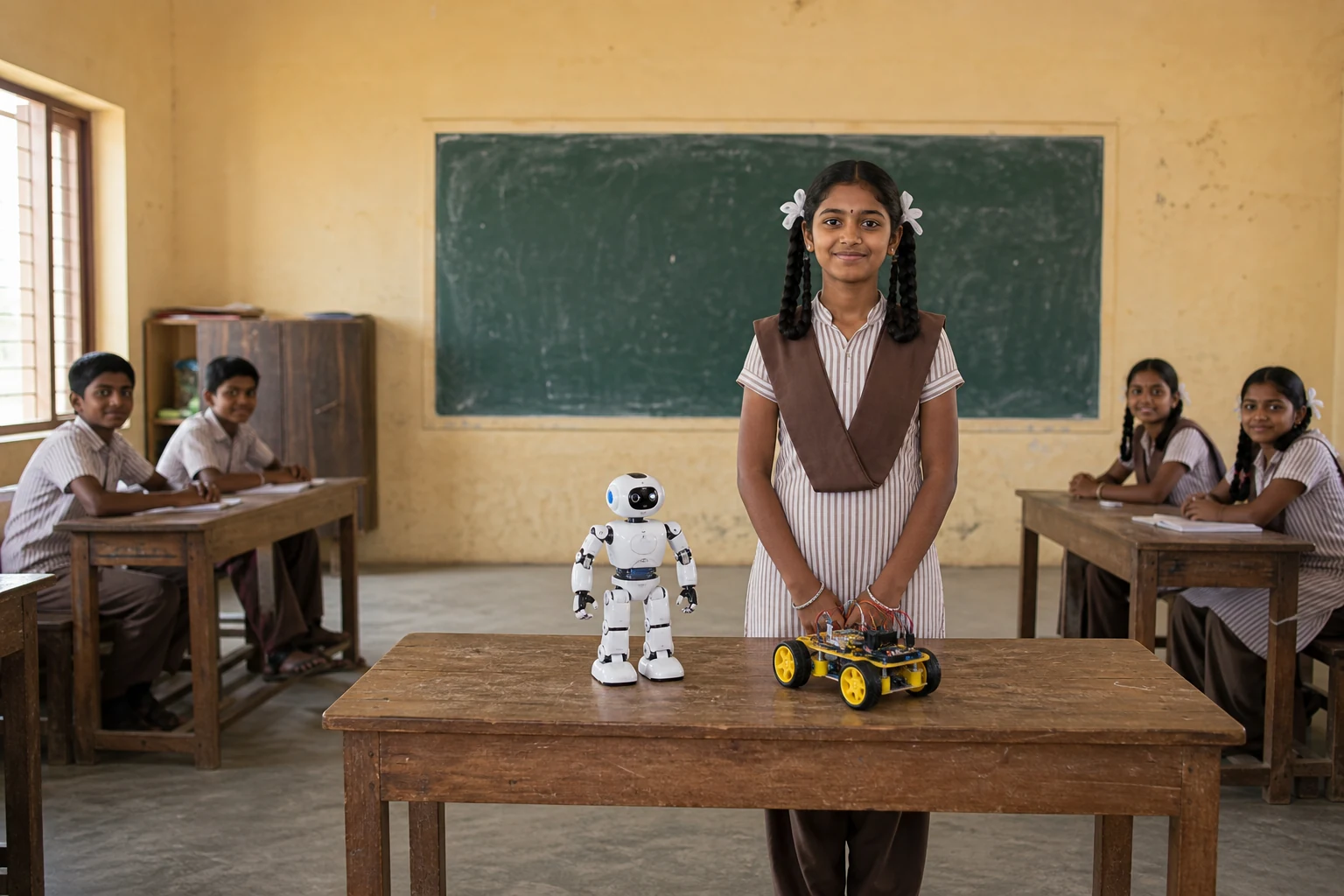
TN-SPARK (AI, robotics, online tools), already in about 5,000 schools, expands by roughly 2,600 more. The intended ladder:
- VI–VIII — foundations
- IX–X — intermediate
- XI–XII — electives
If the kit arrives without a trained teacher, SPARK becomes a press photo. If both arrive, a government-school student in Salem gets a vocabulary her private-school cousin already had.
TN-SPARK: origins and the teacher gap
TN-SPARK grew out of post-pandemic digital catch-up and the state's 2023–24 push to put smart classrooms and coding exposure into government high schools. The name signals ambition; the bottleneck remains human capital. Tamil Nadu trains thousands of B.Ed. graduates annually, yet rural blocks still run on single-teacher primary sections.
Minister R. Kumar's state-level AI portfolio sits upstream of SPARK — policy oxygen without guaranteed district oxygen masks. Opposition voices, including NTK legislators, warn that "AI in schools" without Tamil-medium content and stable power is theatre for urban cameras.
What to watch: weekly period allocation on the official timetable; named teacher in charge; repair ticket when a kit fails; whether girls' schools in minority belts get the same batch as boys' schools in Chennai Corporation limits.
Drug-Free Tamil Nadu in schools adds clubs, volunteer groups, helpline 10581 on walls, and a reporting app (₹7 crore). Treating substance risk as a campus issue — not only a police case — is the policy choice worth watching in industrial and college-town belts.
Substance use among adolescents rose in post-COVID surveys across India; Tamil Nadu's industrial corridors — Coimbatore, Hosur, Tiruppur — combine pocket money, night shifts in family units and easy transit. Clubs only work if counsellors are not imaginary. The helpline number on a wall is step one. Step two is a teacher who knows the referral path without shaming the child in morning assembly.
The commute and the morning meal
About 5.32 lakh Class XI students in government and aided schools are promised branded bicycles with helmets (Puthiya Payanam, Puthiya Vegam, ~₹277 crore). Breakfast extends to Classes VI–VIII. Neither is invented in 2026; both still decide whether a teenager reaches the first period fed and on time.
Breakfast and bicycles — a short history
| Year / era | Scheme | Citizen memory |
|---|---|---|
| 1956 onward | Kamarajar mid-day meal | "Eat at school, stay in school" |
| 1980s–2000s | Uniforms, textbooks, colour TV | Visible state generosity |
| 2011–2021 | Laptop distributions (Jayalalithaa / later DMK) | Devices without repair budgets |
| 2022–23 | DMK breakfast scheme (primary) | First hot meal before first bell |
| 2023–24 onward | Breakfast expansion upward | Middle-school hunger as policy |
| 2026 | VI–VIII breakfast + Class XI cycles | Continuity under new government |
The Puthiya Payanam cycle distribution is a direct descendant of earlier free-bicycle programmes — useful in blocks where the nearest higher secondary is eight kilometres away and the family owns no two-wheeler. Helmet inclusion is new seriousness; previous distributions often treated head protection as optional.
Delivery risks: wrong frame size, distribution after half the academic year, aided-school students left off the master list. Parents should photograph the receipt and frame number — bureaucracy respects serial numbers more than complaints.
Public libraries are to be pushed toward digital learning hubs — useful if the librarian gets bandwidth and devices, decorative if not.
After Class XII: hostels and a laptop
College is where first-generation students often exit. TN-SUDAR imagines 200 integrated hostels and about one lakh beds (₹3,200 crore, PPP). Vetri Laptop aims to put devices in college hands (large Budget allocation reported near ₹2,000 crore). A Madurai law-college excellence track is flagged from 2027–28.
These belong emotionally to education even when the cheque clears under Higher Education. Without a bed and a machine, skill missions described elsewhere stay abstract. (Jobs pipeline.)
TN-SUDAR in PPP mode means land, concession agreements and rent timelines — not hostel keys in year one. Vetri Laptop echoes 2011–12 and 2021–22 laptop moments; the graveyard of dead batteries in college cupboards is a Tamil Nadu tradition the government says it will break with service centres and warranty pools. Skepticism is earned.
Higher Education Minister P. Viswanathan inherits both the promise and the protest line from college unions — fee hikes elsewhere, scholarship delays here. A laptop without hostel space still sends a rural girl home on the 7 p.m. bus through a dark highway.
Opposition voices and the delivery calendar
DMK legislators argue the 2026 package repackages Samagra Shiksha, state plan funds and schemes launched under M. K. Stalin. AIADMK spokesmen point to unfinished buildings from their own tenures and ask why Palli Niraivu lists overlap old pending work orders. Both are partly right. Tamil Nadu's education Budget is a palimpsest — new titles written over old foundations.
NTK and student groups ask sharper questions: Tamil-medium STEM materials, counsellor ratios, and whether anti-drug programming becomes moral policing in small towns.
Citizen calendar: what should happen when
| Window | Expected visible output |
|---|---|
| Aug–Sep 2026 | School-level lists for Super Clean / Palli Niraivu; SPARK kit dispatch starts |
| Oct–Nov 2026 | Cycle distribution peaks; breakfast ration supply audits |
| Dec 2026 | Mid-year building progress before Northeast monsoon repair lull |
| Jan–Mar 2027 | Residential school admission notices; curriculum pilot materials |
| Apr 2027 | Next academic year — full SPARK timetable test |
If milestones slip, the government will blame fiscal inheritance. Parents should blame only the slippage they can photograph.
A parent's short checklist
- Super Clean / Palli Niraivu — are we listed this year?
- Who is the contractor, and what is the due date?
- Does TN-SPARK have a weekly period and a named teacher?
- Bicycle distribution date for Class XI?
- For residential seats — where is the application notice?
- Breakfast — confirmed for our middle-school grades?
Education reform is slow politics. That is why it is the right long bet for a new government — and why this article refuses to pretend a Budget paragraph already fixed your child's classroom.
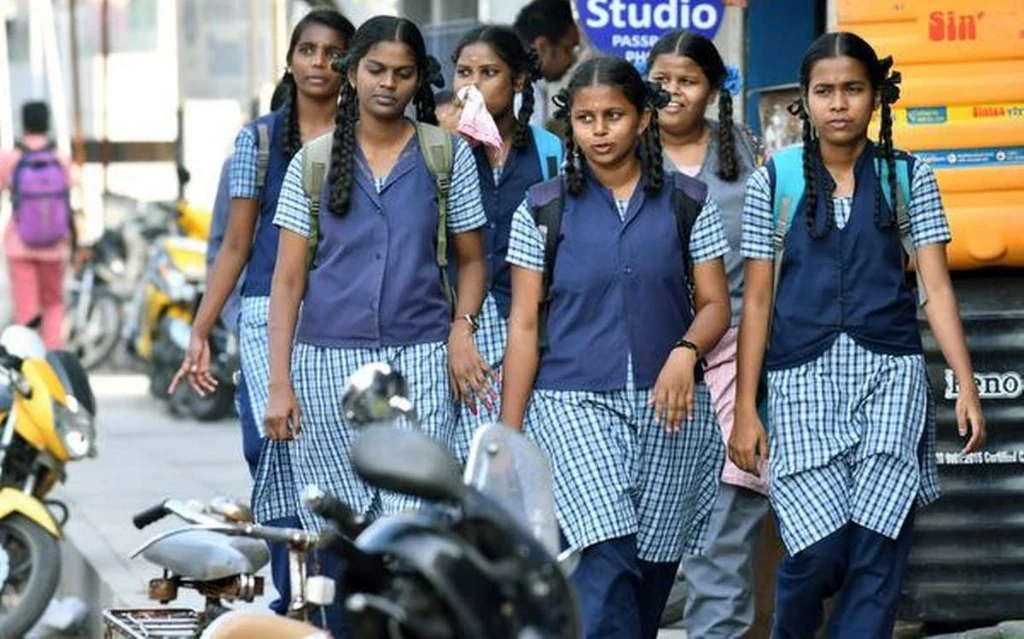
The 2026 Tamil Nadu education story will not be decided in the Assembly chamber. It will be decided in 3,734 school compounds, 10,000 toilet blocks and 7,600 classrooms where SPARK kits either glow or gather dust. Kamarajar bet on a plate of rice. This government is betting on cleaner plates, smarter timetables and beds for children who cannot afford tuition towns. The history is on their side. The contractor ledger is not — until proved otherwise.