They Handed Finance to a First-Time MLA. Then He Told the House the Treasury Needs Years
A Jeppiaar-group educationist and first-time RK Nagar MLA walked into Fort St. George with the hardest file in the cabinet — a debt-heavy treasury and a maiden Budget to write.
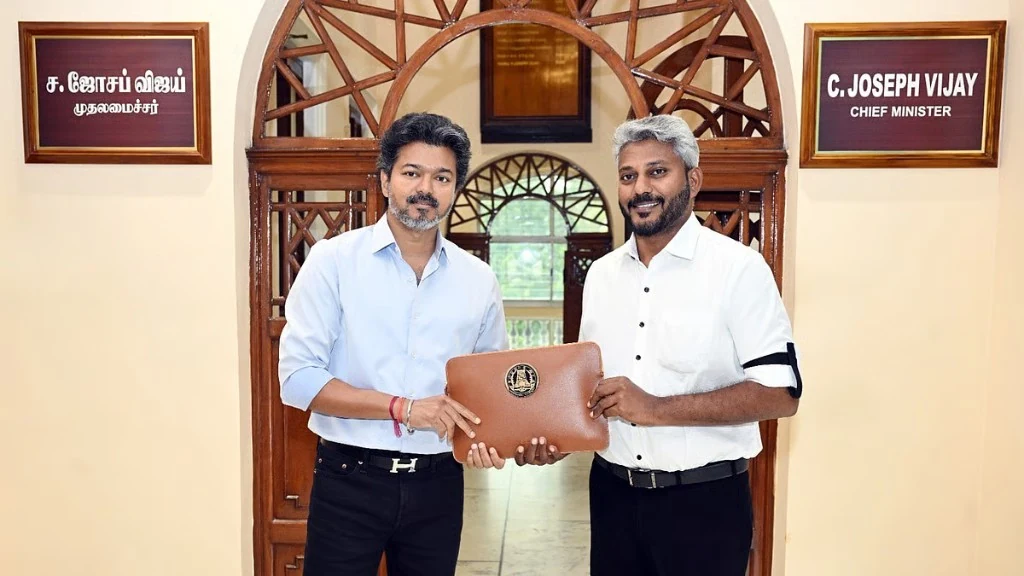
When Chief Minister C. Joseph Vijay handed out portfolios, the Finance file did not go to a assembly veteran. It went to N. Marie Wilson — a first-time MLA from Chennai’s Dr. Radhakrishnan Nagar, an educationist from the Jeppiaar institutional network, and the man asked to present the TVK government’s first Budget while telling the House the treasury needed years, not weeks, to heal.
This profile is about how that pairing happened — and what Wilson’s first major speech revealed about the new government’s money politics.
From campuses to the Cabinet
Wilson (born around 1979, Chennai) built his public identity in higher education long before TVK’s 2026 wave. He holds a B.Tech, an MBA, and a Ph.D. in Management Science from Jawaharlal Nehru Technological University, Hyderabad (2012).
His administrative résumé sits inside the Jeppiaar group:
- Managing Director, Jeppiaar Institute of Technology, Sriperumbudur (from 2011)
- Managing Trustee, Jeppiaar Remibai Educational Trust
- Earlier founder-director roles at Jeppiaar Engineering College and Jeppiaar International School
- Links to campus industry and sports initiatives under the same institutional umbrella
In other words: he arrived in politics fluent in budgets of a different kind — fee structures, trust accounts, campus expansion, accreditation cycles — not Assembly cut-motions. That is precisely why the appointment was read as a technocratic bet inside a debutant party.
The Jeppiaar institutional world Wilson comes from
To understand Wilson as Finance Minister, start with the geography of his career. Sriperumbudur is not an accidental address. It sits inside the same industrial gravity well that pulled auto majors, electronics assembly and engineering colleges toward Chennai’s western arc. Running Jeppiaar Institute of Technology from 2011 meant living inside the tension every private college faces in Tamil Nadu: capitation politics, NAAC visits, placement optics, bus routes that decide rural enrolment, and trust accounts that must balance scholarship rhetoric with balance-sheet reality.
The Jeppiaar Remibai Educational Trust role adds another layer. Trust-run institutions in the state are mini-treasuries — scholarships, staff salaries, building loans, sports infrastructure that parents photograph during open days. Wilson’s doctorate in Management Science is not decorative in that world. It is the vocabulary of operations research applied to queues, staffing and capital allocation — skills that translate awkwardly to state finance, but translate nonetheless.
His links to campus industry and sports initiatives under the same umbrella also explain a political style less invested in stage thunder and more in spreadsheet rehearsals. Education entrepreneurs who survive in Tamil Nadu learn to negotiate with regulators before they negotiate with voters.
Wilson did not learn finance in Fort St. George. He learned it balancing trust ledgers while Sriperumbudur’s factories hummed in the background.
RK Nagar: a loud first win
Wilson contested Dr. Radhakrishnan Nagar for TVK and won decisively in May 2026. Reported figures put him near 54% of the vote (97,800 votes in one official tally), defeating sitting DMK MLA J. John Ebenezer by about 49,668 votes — a margin larger than the runner-up’s total in some counts. DMK and AIADMK together were far behind his share.
RK Nagar is not a quiet academic suburb; it is a politically watched Chennai seat. Winning it this cleanly made Wilson hard to ignore when cabinet berths were mapped.
Why RK Nagar mattered beyond the margin
RK Nagar carries a loaded recent history in Chennai politics — by-election dramas, celebrity candidates, media telescopes. For TVK, winning it was not only about one seat. It was proof that the party could take an urban fortress the DMK held, with a candidate who was not the Chief Minister himself.
Wilson’s 97,800-vote haul and ~54% share sent a message to coalition arithmetic inside the new government: the educationist was electorally legitimate, not merely a technocratic appointee smuggled in through the back door. In a cabinet balancing debutant specialists and old hands, that margin buys room to say unpopular things about debt.
The portfolio
On 21 May 2026, Wilson took charge as Minister for Finance, Planning and Development (including pensions in the formal allocation). The previous heavyweight track in the broader TVK fold saw K.A. Sengottaiyan move to Revenue and Disaster Management — experience to the districts and disaster file; the new doctorate to the Budget speech.
Wilson’s early public line was gratitude without theatre: thanks to the Chief Minister and to RK Nagar voters, and a promise to work the portfolio.
The inheritance: what the Finance chair actually holds
Tamil Nadu’s Finance Minister controls more than a speech once a year. The office sits at the intersection of GST compensation expectations, state borrowings, salary and pension bills, scheme rollout costs, and the quiet warfare between departments that each believe their line item is existential. Wilson inherited that machine in a year when the political mandate demanded visible welfare — laptops, breakfasts, stipends — while bond-market narrators wanted restraint.
Handing Revenue and Disaster to Sengottaiyan while keeping Finance with Wilson was read as a deliberate split: field administration and disaster politics to a veteran; macro numbers and planning vocabulary to the newcomer. Whether that split holds depends on how often crisis spending bypasses the Finance department’s paper trail.
The lineage Wilson walks into: past Finance Ministers
Wilson is not the first Tamil Nadu Finance Minister to arrive with credentials outside traditional Dravidian apprenticeship. He is, however, among the most abrupt transitions — from zero Assembly seasons to the state's hardest briefing in weeks.
P.T.R. Palanivel Thiaga Rajan and the DMK-era benchmark
P.T.R. Palanivel Thiaga Rajan — Stanford MBA, former investment banker, DMK Finance Minister in the early 2020s — became the reference point for a certain kind of Tamil Nadu fiscal moderniser: English-language op-eds, investor calls, transparent debt arguments, fights with the Union on GST dues. PTR's tenure trained journalists and markets to expect a Finance Minister who could speak both to Fort St. George and to Mumbai debt desks.
Wilson is not PTR's photocopy. His doctorate and campus finance background rhyme with technocracy, but his political biography is TVK, RK Nagar and Jeppiaar — not Wall Street. Comparisons are inevitable anyway: every Wilson quote on "realistic" revenue will be measured against PTR's earlier estimates and deviations.
Jayalalithaa-era budgets and the welfare-heavy template
Long before PTR, J. Jayalalithaa's years as Chief Minister — often with Finance presentations shaped by her government's priorities — entrenched a Tamil Nadu expectation: Budget day is welfare theatre plus fiscal assertion. Amma canteens, freebies, gold schemes, laptops — the Jayalalithaa-era budget style taught voters to scan speeches for tangible gifts, not only macro ratios.
Wilson's 2026 speech nodded to that tradition with Annan Seer and education-first lines, while simultaneously asking for two years to restore prudence. That is the Jayalalithaa inheritance filtered through a treasury that now admits ~₹10.9 lakh crore in outstanding liability. The old playbook said announce boldly; the new constraint says admit stress first, then announce.
What changes when Finance is not a lifetime politician
When Finance Ministers rise through decades of party hierarchy, the Assembly forgives opaque lines because the face is familiar. A first-timer must buy credibility with clarity — or get buried in cut motions. Wilson's choice to foreground debt honesty may be partly personality, partly necessity: he has no nostalgic capital to spend.
The maiden Budget test
On 5 August 2026, he presented the revised 2026–27 Budget — the document that now defines him politically. The speech mixed welfare branding with fiscal caution:
- Education-first spending (schools and skills)
- Women-centric schemes such as Annan Seer
- A claim that leakage-plugging had helped mobilise nearly ₹15,000 crore
- An admission that the state remains fiscally stressed, with outstanding liability around ₹10.9 lakh crore and a request for roughly two years to restore prudence
- Own-tax revenue estimates reset toward realism even as growth targets for later years stay ambitious
Opposition leaders called the welfare list a rebrand. Wilson’s counter-frame is administrative: stop the bleeding, fund human capital, buy time. Whether that bargain holds will be measured in deficit ratios and scheme delivery, not in the ovation after the speech.
Budget explained for citizens.
Reading the numbers Wilson chose to foreground
The ₹15,000 crore leakage-plugging claim is politically explosive because it doubles as an indictment of the previous regime and a promise that welfare can expand without new taxes — if databases behave. Markets heard something else: maybe the state had headroom it had not admitted earlier. Either way, Wilson tied his reputation to a number that auditors and Opposition researchers will chase line by line.
The ₹10.9 lakh crore liability figure, paired with a two-year prudence horizon, is the adult sentence in a speech otherwise crowded with laptops and gold. It tells bond buyers that the TVK government knows the constraint. It tells voters that visible gifts now may mean quieter capital spending later — a tension the infrastructure guide already tracks on the ground.
Education-first ordering aligns with Wilson's biography. A Finance Minister who spent fifteen years in college administration will believe human-capital lines are investment, not expense. The risk is capital neglect in roads, metros and industrial estates — the physical rails that make jobs policy credible outside Chennai.
How to read his politics
Wilson is not a mass orator in the Dravidian mould. He is a numbers-and-institutions minister in a government that still runs on charisma at the top. That division of labour can work — if Finance stays boringly competent while the Chief Minister sets political direction.
Watch three gauges:
- Revenue honesty — do collections track the “realistic” estimates he tabled?
- Capital vs welfare balance — after education and gold schemes, does infra get a second wind (projects guide)?
- RK Nagar feedback loop — first-time MLAs fall when local delivery lags; Finance Ministers fall when state credit-rating narratives sour.
Biography as constraint and advantage
Wilson's age cohort — born around 1979 — places him between the Vijay youth wave and the grey-haired specialists TVK also recruited. He can speak to parents worried about college fees because he has set them. He may struggle, initially, with the performative aggression Opposition benches use to unsettle newcomers.
His Hyderabad doctorate matters in subtle ways. JNTU's management science tradition is less Madras University romanticism, more systems thinking — fitting for a minister who must integrate Planning and Development under one roof. Whether that integration is real or nominal will show up in whether capital projects stop dying between Finance clearance and Works department ground-breaking.
The pension file inside Finance
Including pensions in the formal allocation is not ceremonial. Tamil Nadu's salary and pension bill is the glacier that every Finance Minister watches melt upward. Wilson's campus years involved actuarial anxiety of a different scale — staff retirement trusts in private colleges. The state version is larger, louder and politically radioactive. A misstep on pension arrears echoes in every government employees' association WhatsApp group.
Digital receipts and the Finance–IT axis
Wilson's leakage narrative depends on digital governance actually working — unified databases, fewer ghost beneficiaries, faster reconciliations. Finance Ministers rarely headline e-Sevai launches, but they benefit when IT stops fraud. The AI & IT ministry is Wilson's silent partner: if SPEED and the Super App fail, the ₹15,000 crore story weakens in audit.
Place in the TVK story
Wilson’s rise sits beside other debutant specialists in the cabinet — the AI minister from Velachery, doctors in health, contractors in works. The party’s wager is that domain managers can professionalise a breakthrough mandate. Finance is where that wager meets bond markets, GST shares and salary bills.
For the early-term arc that framed his Budget, see 100 days of major decisions. For the political earthquake that made room for him, see the rise of Joseph Vijay.
What the next 24 months will decide
Finance Ministers in Tamil Nadu are remembered in one of three ways: as reformers who convinced markets, as populists who won elections until they did not, or as placeholders who vanished into the Chief Minister's shadow. Wilson enters with a rare profile — education entrepreneur, landslide urban MLA, maiden Budget author — and a rare admission — two years to heal the books.
If own-tax revenues meet "realistic" targets, if leakage savings reproduce in year two, if capital spending does not collapse beneath welfare headlines, Wilson becomes more than the Jeppiaar MD who got Finance. He becomes the fiscal face of a new party's credibility.
If not, RK Nagar's 54% will not shield him. Neither will a doctorate. In Tamil Nadu, the Finance file is where poetry goes to meet arithmetic — and arithmetic always wins.