The Rise of Joseph Vijay
He fought without an ally on the ballot. He won anyway. How a generation made a Chief Minister out of the silent, decade-long accumulation that no analyst measured, or was willing to disclose.
They counted his rallies. They counted his speeches. They counted his alliances, and arrived at zero, because he had none. He fought this election alone.
What they forgot to count was his fans, and the families those fans went home to.
As of the 2026 verdict, Joseph Vijay is the Chief Minister of Tamil Nadu.
His party, Tamilaga Vettri Kazhagam, is roughly two years old. The two political ecosystems it displaced, the DMK and the AIADMK, are seventy-five and fifty years old respectively. Generational cadres. District-level money pipelines. Owned media fronts. Decades-deep foundations and entire family trees of power built around them.
By every measure that matters to a traditional political establishment, bank balance, booth-level network, seniority, governance experience, owned newspapers, friendly television channels, alliance arithmetic, Vijay should not have been competitive in this election. He had none of those. He didn't even have an alliance partner. He stood alone on the ballot.
He didn't just win. He dethroned two giants of Dravidian politics, solo, in less time than it takes most parties to print their first batch of flags.
The structures that had ruled this state for half a century did not lose to a bigger structure. They lost to something they could not see. To understand how that was possible, stop looking at the last twelve months. Look at the last thirty-four years.
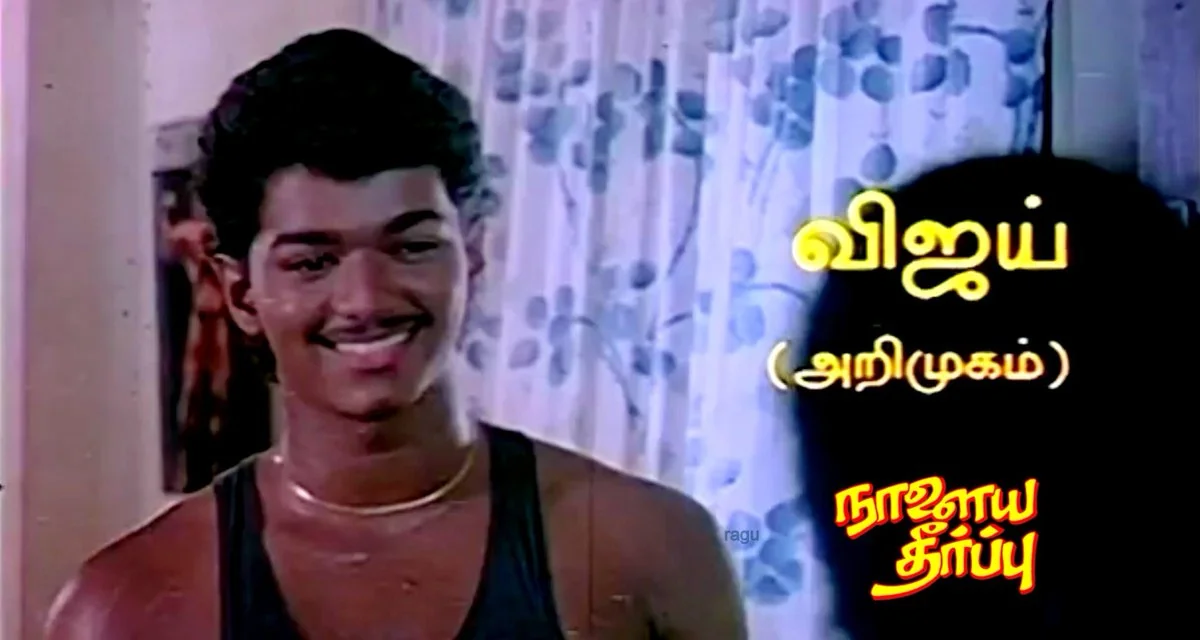
நாளைய தீர்ப்பு — Tomorrow's Verdict
That was the title of his first film, in 1992. He was a teenager with a sleeveless vest and a nervous smile, getting an "introducing Vijay" card.
Thirty-four years later, Tamil Nadu delivered the verdict he had been auditioning for all along.
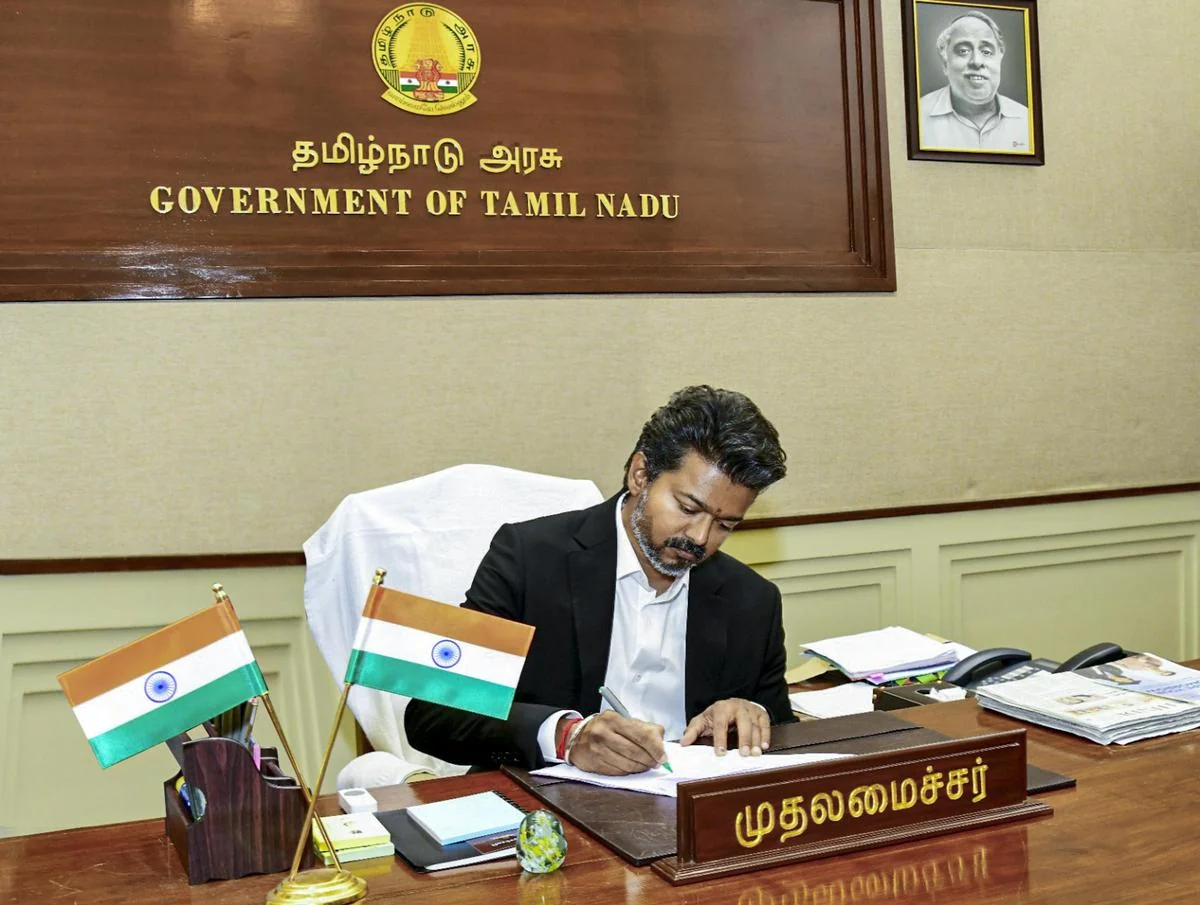
On his first day at the Secretariat, the room went quiet for a moment that did not belong to any party machine. The Government of Tamil Nadu seal on the wall. The Anna portrait above the desk. The brass tricolour on the table. And a man who had spent three decades being looked at by audiences, now sitting down to look at a file.
To understand that morning, you have to rewind the years.
The mistake every analyst made
For years, mainstream political analysis in Tamil Nadu tried to measure Vijay only through rallies, speeches, alliances and television visibility.
What most analysts missed, or chose not to say openly, was that his political capital was being built long before the party machinery became visible.
This was not a sudden political wave. It was a silent social accumulation.
Wave metaphors assume an event. Accumulation is what happens between events, when no one is filming. By the time the panels began discussing his rise seriously, the groundwork had already been laid: not through one campaign, not one slogan, not one alliance, but through a million small conversations the analysts were never invited to.
The "reset candidate"
Unlike traditional Dravidian politics, Vijay entered without decades of ideological baggage, corruption allegations, faction wars, or inherited political enemies.
That mattered more than analysts initially understood. Tamil Nadu voters were not just evaluating a politician; they were comparing emotional fatigue. After years of watching entrenched political ecosystems, many people saw Vijay as a reset candidate. A new player with almost no old luggage.
He was also careful about absorption. Unlike parties that become shelters for mass defectors from rival camps, Vijay largely avoided becoming a dumping ground for rejected politicians. A few faces came in, but the movement never looked like recycled politics wearing a new shawl.
That preserved credibility among younger voters in a way no manifesto could.
Five emotional pillars
He did not attempt to reinvent Tamil Nadu politics ideologically. He played on the strongest emotional basics already embedded in Tamil society:
- Women's safety
- Anti-drug messaging
- Social justice
- Welfare sensitivity
- A visible position that all religions must coexist politically
That last point became critical.
In a state where BJP expansion triggered anxiety among several communities, Vijay carefully occupied a space where minorities, secular Dravidian voters and politically neutral families could emotionally gather without feeling aggressively ideological.
He was not speaking as a revolutionary intellectual. He was speaking as a cultural comfort zone.
And in a state tired of being asked to pick a side in someone else's war, comfort is a political weapon.
The opening on the other side
Both major political poles showed weakness in different ways.
Edappadi K. Palaniswami struggled to create emotional mass energy beyond party structure. His politics remained organisationally relevant but lacked inspirational pull among first-time voters.
M. K. Stalin, despite administrative control and a strong party ecosystem, inherited another challenge: long-term anti-incumbency fatigue toward established political families and systems. For many younger voters, the DMK represented governance, but not aspiration.
Both poles left a door open. Vijay did not even knock. He walked through it like the room had been waiting for him.
The Gen Z chapter: when fandom became infrastructure
This is where Vijay's biggest invisible advantage emerged.
Political observers underestimated how deeply cinema fandom had transformed into digital-age political identity. A generation that grew up watching Vijay films was now entering voting age during a period of unemployment anxiety, corruption fatigue, online political exposure and institutional distrust.
For older generations, fandom was entertainment. For younger generations, fandom became community.
That distinction changed everything.
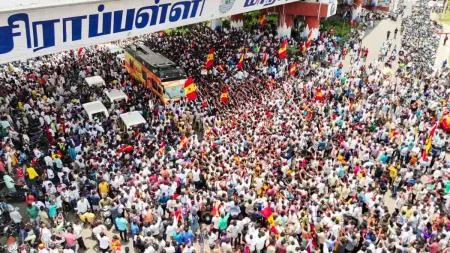
Thousands of first-time voters did not enter politics through party offices. They entered through fan pages, WhatsApp groups, Instagram edits, YouTube debates, meme culture and local volunteer circles. Over time, these networks evolved into decentralised political infrastructure.
In many neighbourhoods, the campaign did not look like traditional cadre politics. It looked personal:
- A son convincing his father.
- A college student debating in tea shops.
- A granddaughter explaining corruption issues to grandparents.
- Apartment WhatsApp groups discussing change after dinner.
- Young women campaigning quietly inside families.
That is politically dangerous energy for established parties because it bypasses every channel a party knows how to attack. You cannot run a smear campaign against a son's tone of voice in his mother's kitchen.
White and brown: when a dress code became a festival
In the final 48 hours, something happened that no campaign manual predicted.
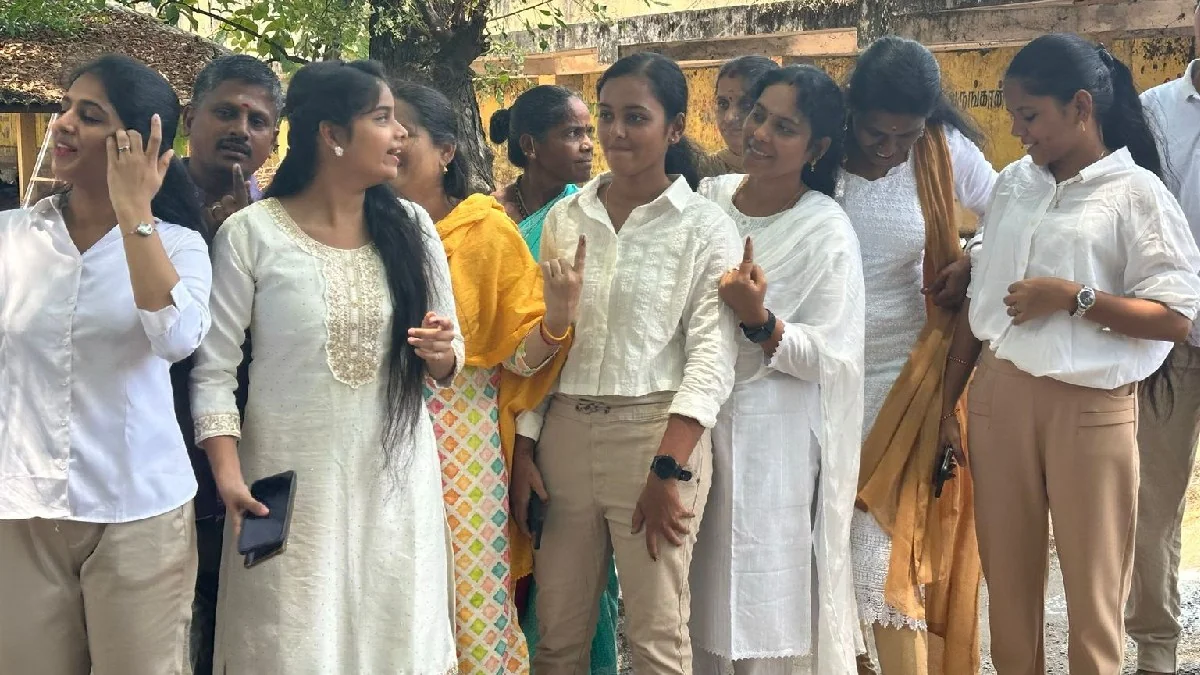
Across cities and villages, young first-time voters started turning up in the same uniform: a clean white shirt or kurta, paired with brown trousers, beige chinos or a brown dupatta. And from the morning of voting day, a freshly inked finger held up for every camera in sight.
It was not a directive. There was no party SMS telling people what to wear. It spread the way fashion spreads online: through reels, stories, college WhatsApp groups, neighbourhood selfies.
Friends colour-coordinated the night before. Apartment blocks compared fits in the lift. Sisters lent each other dupattas. White and brown stopped being a wardrobe choice and became festival wear.
On polling day itself, queues outside booths in Coimbatore, Madurai, Chennai, Tiruchirappalli and Salem looked less like a sober civic duty and more like a temple festival the day after harvest. Photographs of strangers posing together, fingers up, fits matched, went viral by lunchtime.
The act of voting had been re-coded. From a chore to the proudest selfie of the year.
Somewhere in the back of every booth queue, an opponent's campaign manager was watching a video on his phone and feeling his stomach drop.
How a dress code flipped a generation of parents
The most underestimated thing about that white-and-brown statement was not how the youngsters looked. It was how their parents and grandparents looked at them.
Older voters who had spent weeks privately saying they would "stick with what we know," meaning DMK, AIADMK, the familiar loyalties of a lifetime, watched their daughters lay out white kurtas the night before. Watched their sons iron a white shirt at 6am and pick out the brown trousers from the back of the cupboard. Watched a granddaughter explain, calmly, why she was walking to the booth in formation with her friends.
That confidence was difficult to argue with.
A child showing up dressed with intent, eyes clear, phone charged, plan made, is not a child you can dismiss as "not understanding politics." That is a child telling you, without raising her voice, that she has thought about this longer than you have.
In thousands of homes, the conversation in the auto on the way to the booth was a quiet one.
A father looked at his son's ink-marked finger held up for a selfie, and changed his vote in his head before he reached the door. A grandmother watched her granddaughter pose with her friends and decided, on the spot, that she would press the same symbol.
The young did not have to convince the old with arguments. They convinced them by looking like they already knew the answer.
And somewhere inside that quiet handover, parents who had voted the same way for forty years pressed a new symbol for the first time in their lives. Not because they had been persuaded by a speech, but because their child had taken their hand and walked them to the booth.
That is when opponents knew it was over.
When a generation puts on a uniform of its own choosing, walks to the booth as a celebration, and pulls the household with it, turnout numbers stop being an estimation problem. They become a counting problem.
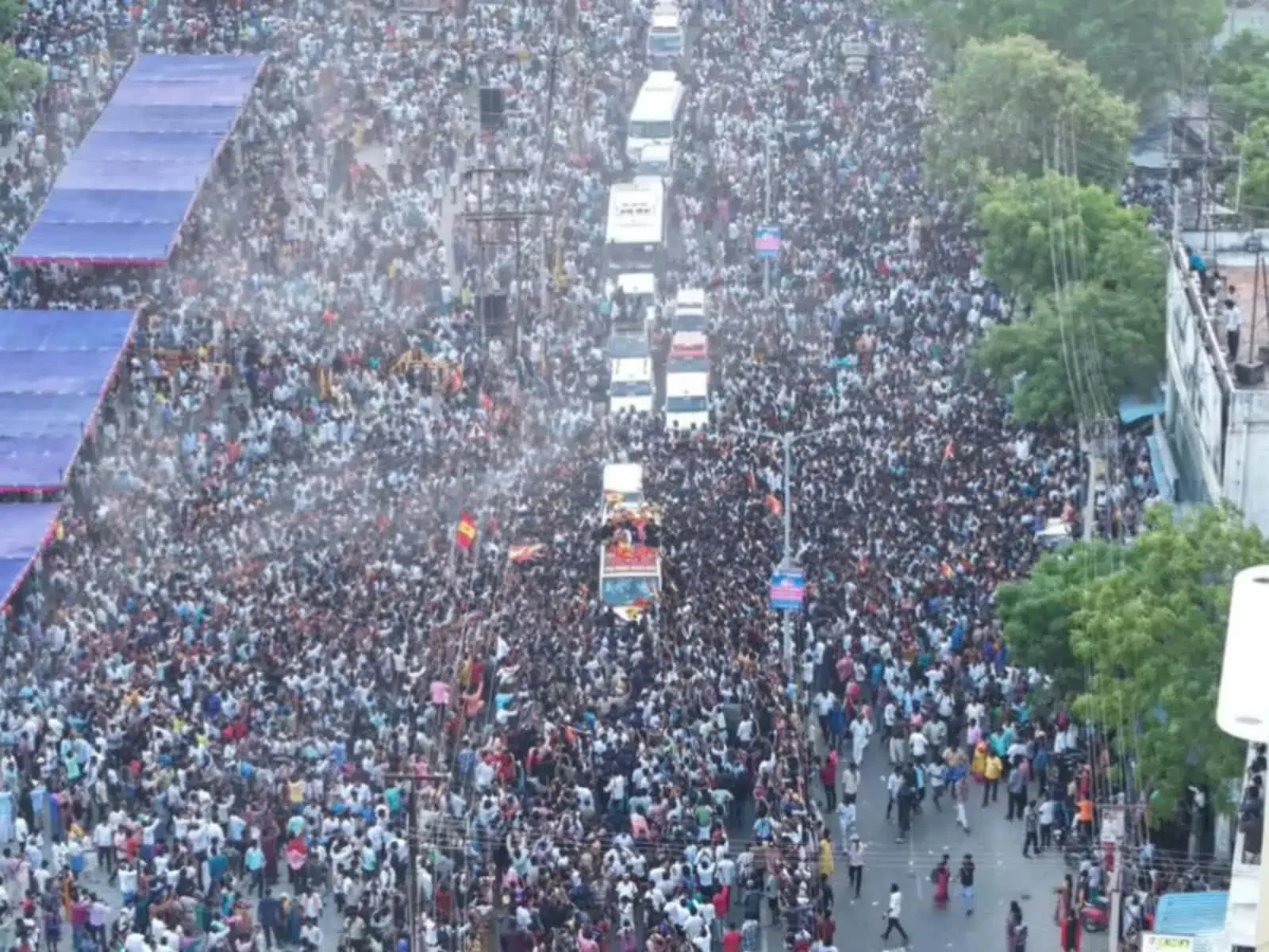
"We have to win this"
Somewhere between 2024 and the verdict, the language changed.
It stopped being "I support Vijay" and became something flatter, harder to argue with. We have to win this.
That shift, from spectator to shareholder, was the most underrated political development of the decade in Tamil Nadu.
And it had a structural consequence that was devastating for opponents: no one waited for instructions.
IT employees printed voter slips after office hours. Auto drivers offered free rides on polling day. Diaspora workers in Singapore and Sharjah designed Tamil-language explainer reels on weekends. Nobody had told any of them to. Nobody had to.
The other half of the army never left their phones. They called themselves virtual warriors, and they earned the name.
- College kids running 24-hour war rooms out of hostel rooms.
- Designers turning every opposition press conference into a counter-meme within minutes.
- Fact-checkers on X and Reddit chasing down doctored videos before they could trend.
- Reels editors cutting year-old governance failures into 15-second clips that travelled farther than any prime-time bulletin.
- Telegram and WhatsApp admins running booth-level intelligence on which families needed a follow-up call.
They did not have business cards. They had usernames. And between them, they out-fought a political establishment that still thought the battlefield was a television studio.
A decentralised army, physical and virtual, with no central command has no chokepoint to bribe, no spokesperson to discredit, no party office to raid.
You cannot decapitate something that has no head. You can only watch it move.
How a generation dismantled every anti-Vijay narrative
The opposition tried the standard playbook. Each attack ran into a counter that the playbook had no answer for.
- "He's just a film star." Met with three decades of his own film clips in which his characters spoke exactly the politics he now speaks. Fans turned cinema into political evidence faster than any party could write a press note.
- "His party has no cadre." Met with 24-hour war rooms run out of college hostel rooms. Every hashtag attack was countered with a counter-trend within hours, in Tamil and English, with original art.
- "He runs from the press." Met with evidence: the Vijayakanth and Annamalai trajectories. Fans framed restraint as discipline, not avoidance. Over-exposure killed others. Silence protected him.
- "He has no governance experience." Met with policy explainer reels, Tamil-language fact threads, and infographics on women's safety, drug seizures, MSP and education policy. The audience did not need him to look like a bureaucrat. They needed him to sound like a priority-setter.
- "His rallies are paid crowds." Met with thousands of geo-tagged, time-stamped phone videos uploaded by ordinary attendees. The crowd authenticated itself.
The opposition was fighting yesterday's media war on television panels. Vijay's army was fighting in formats the opposition did not even read.
By the time the press conferences ended, the counter-edits were already trending in three languages.
The discipline of silence
To a large extent, Vijay appeared to study the trajectories of Vijayakanth and parts of K. Annamalai.
Vijayakanth showed how quickly media narratives can shape public perception once constant exposure begins. Annamalai showed both the power and the risk of hyper-visible media politics.
Vijay stayed relatively controlled and distant: limited access, fewer uncontrolled debates, minimal daily noise.
This created two advantages simultaneously:
- Supporters projected their own hopes onto him.
- Opponents struggled to create sustained negative narratives.
The media ecosystem could attack speeches. It could attack statements. It could attack controversies. What it struggled to attack was silence backed by emotional goodwill.
You cannot run an attack ad against a man who has not given you a quote in six months.
What counting day actually meant
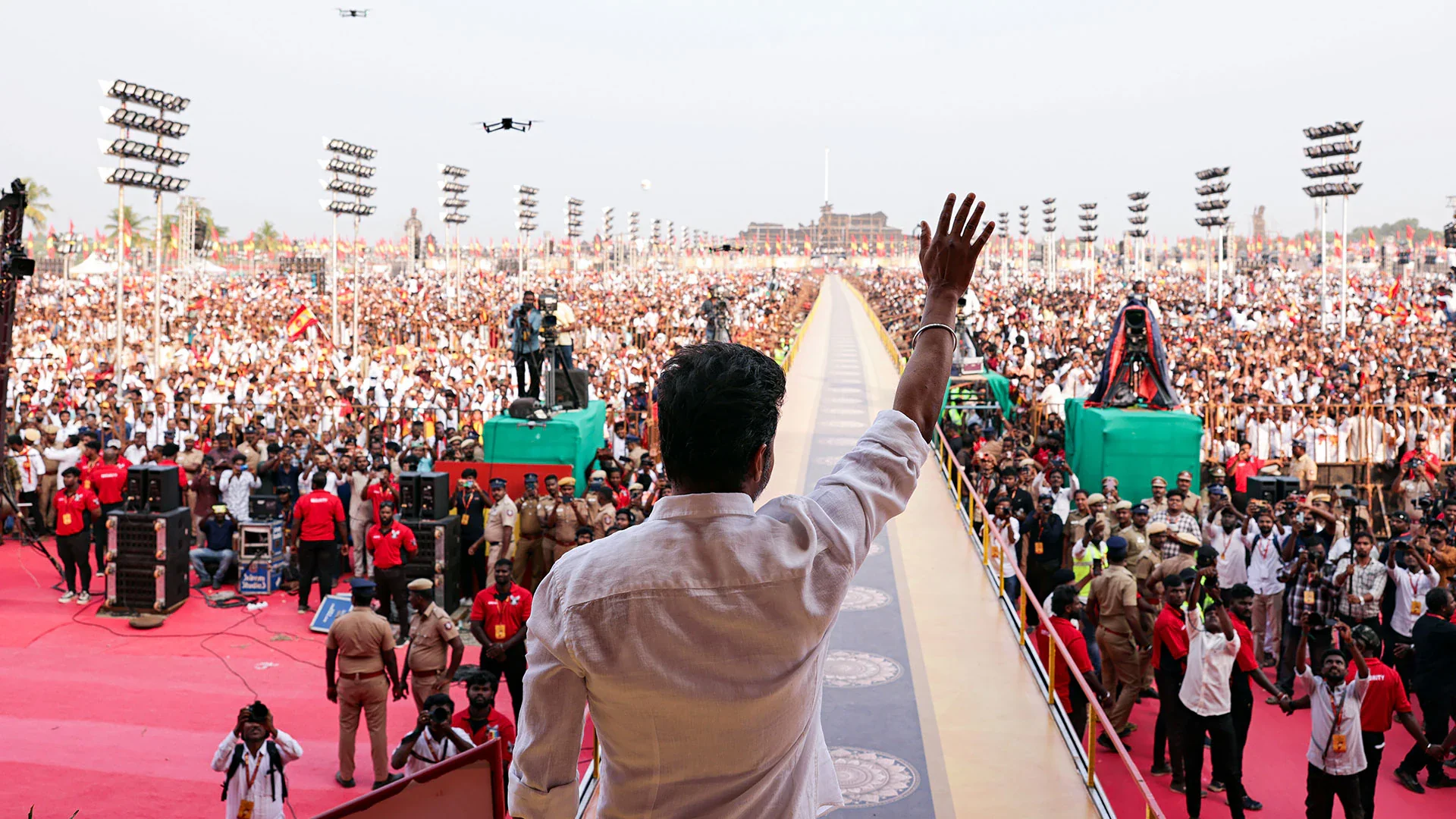
The verdict was not just a Chief Minister change. It was a generational handover, and an inter-generational handshake.
A voter cohort that grew up online, that watched institutions struggle to keep up with their lives, that inherited a political conversation it did not start, chose differently. It chose together. And it persuaded its parents and grandparents to choose with it.
Many conventional observers will someday look back and realise they misunderstood the movement entirely. They thought they were watching a celebrity testing politics.
What was actually happening was a generational voter transition unfolding quietly beneath mainstream political commentary. Fans pulling families. Families pulling neighbourhoods. Neighbourhoods pulling towns.
They thought they were watching a man rise. They were actually watching a generation arrive.
Editor's note: This is an opinion piece, not a data tabulation. It draws on observable patterns of the 2024–2026 cycle and on the verdict that followed. For the underlying numbers, every constituency, every margin, every winner, see the rest of TN Verdict.