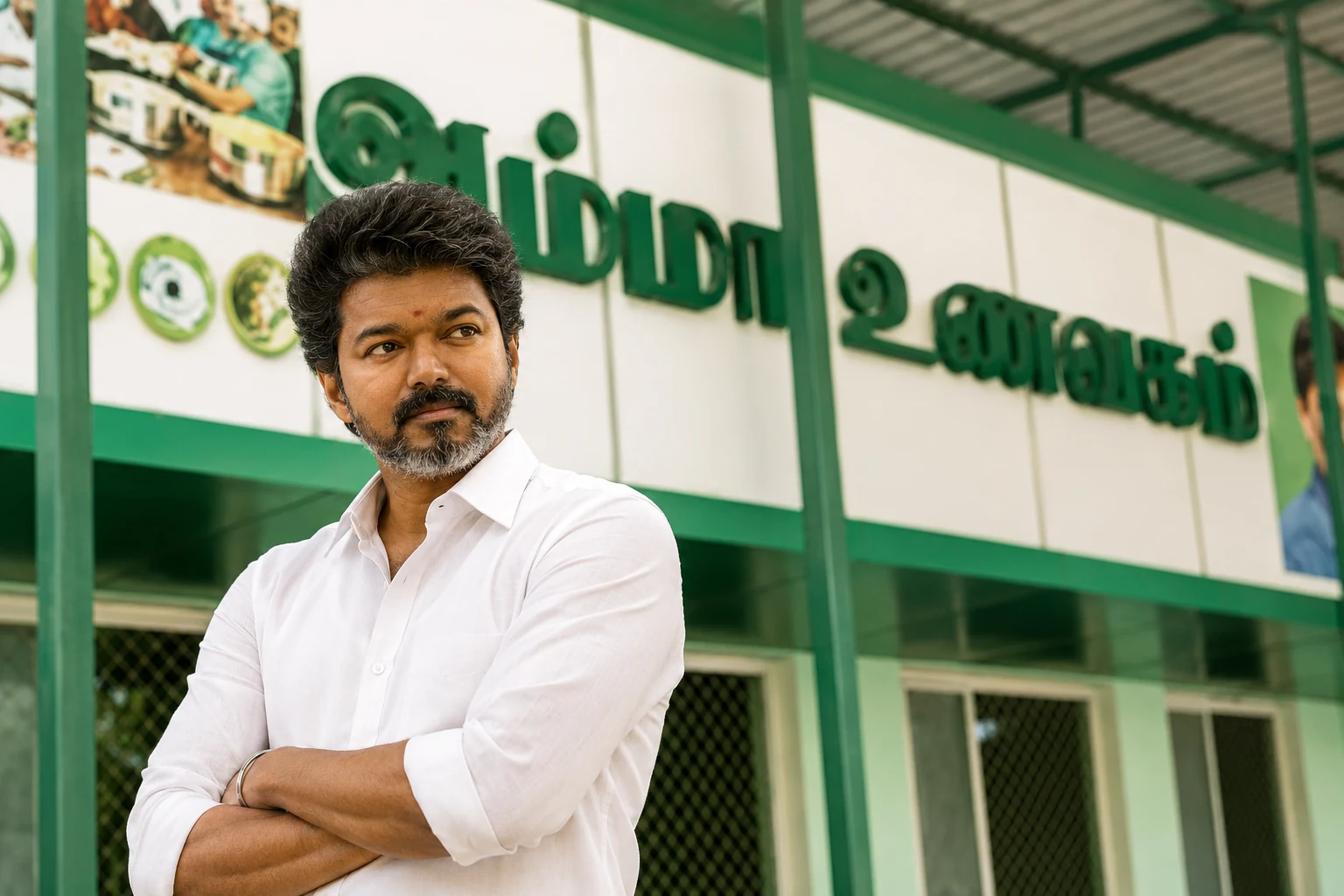
Thin Sambar Emptied the Queues. Then Amma Unavagam Crossed One Lakh Diners Again
Thin sambar and tired steamers emptied the queues. After CM Vijay’s kitchen order and ₹17.6 crore of Chennai repairs, daily diners crossed one lakh again.
Before it is a political argument, Amma Unavagam is a steel plate and a queue. Idli in the morning, sambar rice at noon, a price that still feels possible for a construction worker or a patient’s relative camping outside a government hospital.
The canteens began in 2013 under J. Jayalalithaa — trial run in Saidapet, then a citywide and statewide net. Other parties inherited them. None could shut them without paying a social cost. By early 2026, the threat was not closure. It was neglect: weaker batter, thinner gravy, fewer gas cylinders, equipment that had not been replaced since the last serious upgrade cycle.
That is the story Chief Minister C. Joseph Vijay walked into — and chose to own.
How a Saidapet pilot became a statewide institution
Jayalalithaa launched Amma Unavagam in February 2013 with a single outlet in Saidapet, Chennai. The logic was straightforward: Tamil Nadu already ran one of India’s most extensive welfare kitchens through mid-day meals and the Public Distribution System. A municipal canteen network would catch people the ration card could not always reach in real time — the day labourer between job sites, the migrant between districts, the family that had spent the morning at a government hospital and needed a hot meal before the bus home.
The pilot worked. Within months, Chennai Corporation expanded the model ward by ward. By late 2013, the city had hundreds of outlets. The AIADMK government then rolled the brand statewide through urban local bodies, attaching the Amma name to a price point that became part of Tamil Nadu’s social contract: idli at a few rupees, sambar rice at a price that still made sense on a construction worker’s daily wage.
When the DMK returned to power in 2021, it did not dismantle the canteens. That continuity matters. Tamil Nadu’s Dravidian parties have fought over branding for decades — gold schemes, laptop colours, canteen names — but the underlying welfare architecture tends to survive transfers of power because voters treat abrupt cuts as betrayal, not reform. Stalin’s government kept Amma Unavagam running even as it launched its own breakfast expansion and nutrition programmes. The 2026 TVK administration inherited the same pattern: a rival-era name on a file that could not be closed without visible pain.
What was going wrong in the kitchens
Staff and local representatives had been saying the quiet parts out loud for months. In some outlets, weekly LPG supply had tightened. Oil and urad dal quantities were described as sharply cut compared with earlier norms — the kind of “savings” that show up immediately in taste. Mobile Amma units launched in earlier years had faded from neighbourhood sightlines. A 2024 Greater Chennai Corporation allocation of about ₹7 crore for equipment at hundreds of outlets had not, in public memory, translated into a lasting turnaround.
The deterioration was not mysterious. Municipal canteens run on three fragile inputs: provisions (dal, oil, rice, vegetables), equipment (steamers, grinders, gas connections) and supervision (inspectors who actually eat the food). When any one slips, footfall drops before any newspaper notices. Diners are not loyal to a party logo. They are loyal to a plate that tastes the same on Tuesday as it did last month.
When food quality falls, the first people to leave are the ones the scheme was built for. Footfall in Chennai’s first months of 2026 sat in a band well below one lakh a day — April’s average around 67,164. That number is not abstract. It represents tens of thousands of working poor who quietly decided the queue was no longer worth their lunch break. Railway hubs and hospital zones generate the hardest traffic — migrants, patients’ families and shift workers who cannot cook mid-day.
The order: repair, don’t rebrand
In mid-May, after complaints reached the Chief Minister’s office, Vijay reviewed the file with senior officials and ordered a statewide reset:
- Renovate rundown outlets
- Buy cooking equipment that actually works
- Restore provision quality
- Pay for it from municipal corporation and municipality general funds — not wait for a celebratory new scheme name
The instruction was deliberately boring. A new government that had spent a decade in opposition could have renamed the canteens, slapped fresh signage on the wall and claimed invention. Vijay chose repair instead — a decision that said the mandate would be measured at the counter, not on a banner. For a party that broke Tamil Nadu’s fifty-year Dravidian duopoly in 2026, keeping a Jayalalithaa-era brand running was its own kind of political maturity.
Greater Chennai Corporation runs 383 canteens (about one per ward, including hospital outlets in zones such as Royapuram, Anna Nagar and Teynampet). Other local bodies run about 237 more across the state. The CM set the standard; commissioners and municipal engineers had to spend.
What Chennai did with ₹17.6 crore
GCC Commissioner G.S. Sameeran later put a number on the capital’s effort: about ₹17.6 crore on major repairs and refurbishments, plus plumbing, equipment and maintenance follow-through. Senior officers intensified inspections — the unglamorous part that decides whether a steam table stays clean after the photographer leaves.
The work was granular. Leaking roofs got patched. Gas lines that had been jury-rigged for years were replaced. Grinders that had been producing gritty batter were swapped out. Provision contracts were reviewed so that oil and urad dal quantities returned to norms that staff remembered from the scheme’s stronger years. None of this made for viral campaign content. All of it showed up in taste.
Then the queues changed.
| Daily diners (Chennai avg.) | Monthly sales | |
|---|---|---|
| April 2026 | ~67,164 | ~₹87.6 lakh |
| June 2026 | ~1.04 lakh | ~₹1.36 crore |
June alone: about 31.23 lakh beneficiary visits and ₹1.36 crore in sales. January–June together: more than 1.5 crore visits and about ₹6.53 crore in sales revenue. That is roughly a 55% rise in daily patronage from the April trough — not a miracle, a kitchen returning to baseline competence.
Amma Unavagam did not need a new name in 2026. It needed dal, oil, working burners and someone who checks the plate.
Why this scheme sits outside the ration shop
The Public Distribution System feeds households with cards. Tamil Nadu’s PDS story is long — ration shops that survived every government since the Dravidian model took root in 1967, expanded under the National Food Security Act, and became the backbone of household grain supply. NFSA entitlements reach families on a monthly cycle. They do not solve the problem of a worker who left home at five in the morning and will not see a kitchen until night.
Amma Unavagam feeds people in motion — migrants between districts, day labourers without a fixed kitchen, families between hospital visiting hours. Subsidised municipal food is how Tamil Nadu covers the gap NFSA paperwork cannot always reach in a single afternoon. The canteens also sit beside the state’s mid-day meal programme, which feeds schoolchildren inside campuses. Amma Unavagam catches everyone else: the auto driver who skips breakfast, the ward attendant who eats standing up, the elderly person who finds cooking alone harder than queuing.
That is also why party workers tasting sambar for the camera created a backlash in some districts: the public wants the state accountable for the plate, not informal cadres issuing instructions to municipal staff. Governance and campaign energy are not the same tool. When TVK supporters staged informal “quality checks” at outlets after Vijay’s order, municipal officials and opposition leaders pushed back for the same reason — the canteen belongs to the corporation commissioner’s file, not a booth committee’s afternoon outing.
Hospital belts, industrial zones and the geography of demand
Not every canteen sees the same crowd. Outlets near government hospitals — Royapuram, Omandurar, Kilpauk corridors — serve patient attendants who may spend days on a plastic chair and cannot afford canteen prices inside private hospitals. Industrial belts in Ambattur, Guindy and the southern IT corridor catch shift workers whose lunch window is thirty minutes. Railway-adjacent wards near Chennai Central and Egmore see migrants who eat once and move on.
The revamp’s early numbers are Chennai-heavy because GCC had both the canteen density and the ₹17.6 crore repair envelope to show results quickly. The 237 non-GCC outlets across Tamil Nadu — run by corporations and municipalities in Coimbatore, Madurai, Tiruchirappalli, Salem and smaller urban bodies — depend on the same provision norms but not always the same capital budget. A diner in Tiruppur or Thoothukudi will judge the scheme by whether their local outlet got new steamers, not by Chennai’s June footfall chart.
District rollout is uneven by design when funding sits in municipal general funds. Wealthier urban bodies can front-load repairs. Smaller municipalities may phase equipment purchases across financial quarters. Citizens outside Chennai should watch their corporation’s council meetings and budget annexures for Amma line items, not only state-level press notes.
Politics without renaming: continuity as a test
Tamil Nadu’s welfare politics often confuse branding with delivery. Jayalalithaa’s era gave the state Amma Unavagam; later governments kept the kitchens alive under new logos. TVK’s early choice was different: repair the plate, keep the name. That is this article’s story — not the wider scheme list.
Amma Unavagam sits in a different category. It is not a 2026 invention. It is inherited infrastructure that the new Chief Minister chose to fix rather than rebrand. That choice intersects with the broader story of what changed after the 2026 election: a party that had never governed before now owns files launched by rivals, and voters will measure competence at places that predate the TVK logo.
Opposition leaders who call the kitchen order “continuity, not innovation” are partly right. Supporters who call it “delivery without ego” are also partly right. The structural point is simpler: subsidised food survives governments because hungry people vote on the plate.
What still has to go right
A one-season repair can fade. Watch for:
- Provision norms published and funded — if dal and oil slip again, footfall will too.
- Replacement cycles — steamers and grinders from the 2010s need a calendar, not emergency purchase orders.
- Parity beyond Chennai — 237 non-GCC outlets are easy to forget when the capital’s numbers look good.
- Hospital and industrial-belt hours — demand peaks where shifts and visiting times actually are.
- Price discipline — the political contract breaks if “subsidised” stops meaning affordable.
Municipal finance is the hidden variable. Amma Unavagam is not funded like a standalone state scheme with its own Budget headline. It lives inside corporation general funds alongside street lighting, storm drains and ward salaries. When urban bodies face revenue pressure, kitchen maintenance is an easy deferral — until footfall collapses and the Chief Minister’s office receives complaints again.
Inspection culture matters as much as capital spend. A refurbished outlet can slide back in ninety days if provision contractors cut corners and no officer tastes the sambar. GCC’s intensified inspections after May were not ceremonial. They were the difference between a one-quarter rebound and a sustained recovery.
Reading the numbers responsibly
The jump from 67,164 to 1.04 lakh daily diners is real, but context helps. April may have been an unusually weak month — summer heat, school holidays shifting some demand, provision shortages that had already been building. June’s 31.23 lakh monthly visits include repeat customers who eat twice a day. Sales revenue of ₹1.36 crore in June reflects subsidised prices, not full commercial rates; the figure measures throughput as much as profit.
Still, the direction is unmistakable. More people returned when the food improved. That is the scheme’s original promise from 2013, restated without a new name in 2026. For a citizen, the verification method has not changed: stand in the queue, eat the meal, decide whether the state still earns your trust one plate at a time.
The point of the plate
Tamil Nadu will keep arguing about new gold schemes and laptop brands. Those fights belong in other articles — the 2026 schemes guide and the Budget explainer cover the fresh branding. Amma Unavagam’s 2026 chapter is narrower and older: can a government still make a cheap hot meal trustworthy?
For a few weeks in May and June, Chennai’s answer showed up as a longer queue and a fuller till. That is not the whole welfare state. It is one of the few parts you can verify before the tea cools. In a year when Tamil Nadu broke a fifty-year habit of single-party Dravidian rule, the most honest governance test may still be the oldest one — whether the person in front of you gets a full plate of rice and sambar at a price that respects their wage.
For the political timeline that put Vijay in the chair to sign that kitchen order, read the first 100 days. For how the 2026 verdict reshaped power at Fort St. George, start with what changed after the election. The canteen story connects both: inherited welfare, new authors, same queue.